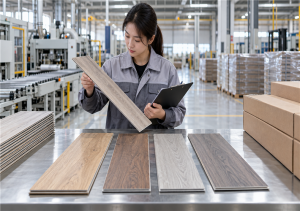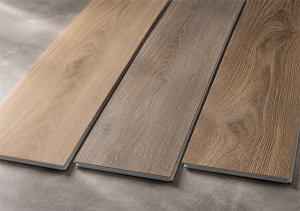
For buyers sourcing SPC flooring, the click lock profile is more than a small detail on the edge of a plank. It affects joint appearance, installation efficiency, panel stability, sample approval, and the consistency of repeat orders. Two products may have the same thickness and decorative film but perform differently because their joint design and manufacturing control are different.
This guide explains how to compare SPC flooring click lock profiles, what to inspect on samples, which production factors influence joint quality, and what questions to ask an SPC flooring manufacturer before placing a wholesale or private-label order.
What Is an SPC Flooring Click Lock Profile?
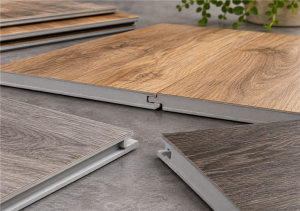
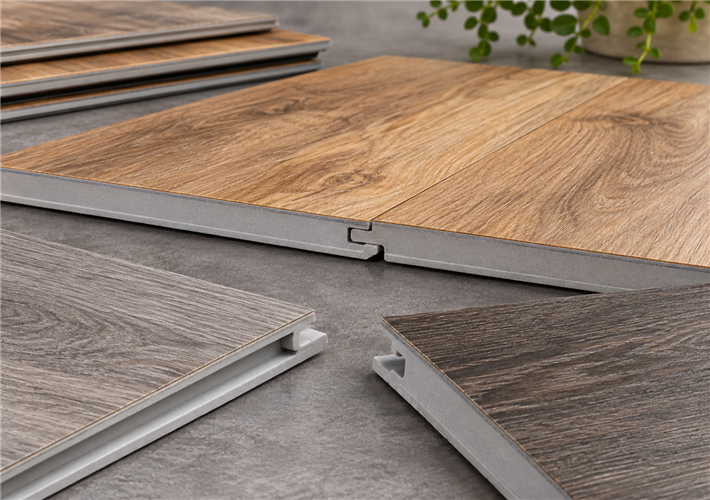
A click lock profile is the molded or machined geometry along the edges of an SPC flooring plank. The profile allows adjoining planks to connect and helps maintain a continuous surface after installation. Depending on the product design, the joint may use a tongue-and-groove structure, an angle-angle connection, a drop-lock connection, or another engineered locking geometry.
The profile must match the core construction, plank dimensions, wear layer, backing, and intended installation method. It should not be evaluated as an isolated shape. The important question is whether the finished plank forms a clean, stable, and repeatable joint under normal handling.

Why Click Lock Quality Matters in SPC Flooring
A well-controlled click lock profile helps the buyer achieve a more consistent finished floor and a more predictable installation process. Poorly controlled joints can create visible gaps, raised edges, chipped corners, excessive installation force, or movement between panels.
For importers, distributors, and private-label brands, joint quality also affects claims and customer feedback. A product that looks good in a catalog can still create problems if the profile is difficult to assemble or changes from one production batch to the next.
- Joint appearance: the seam should be tight and visually consistent across approved samples.
- Assembly feel: panels should connect with controlled force and without unnecessary damage.
- Dimensional stability: the profile should remain compatible when planks experience normal temperature variation.
- Repeatability: the same design should be reproduced across production runs.
- Packaging protection: edges and corners must survive packing, transport, and handling.
Common SPC Flooring Click Lock Profile Types
Tongue-and-groove profiles
A tongue-and-groove profile uses a projecting section on one edge and a matching channel on the opposite edge. The geometry can be engineered for different assembly directions and locking behavior. Buyers should inspect whether the tongue is cleanly formed, whether the groove is free of debris, and whether the joint closes evenly along the full plank length.
Angle-angle profiles
Angle-angle systems are designed so one plank is positioned at an angle and then lowered into the adjoining plank. They can be efficient for certain installation sequences, but the sample should be tested for edge chipping, corner strength, and the amount of force needed to close the joint.
Drop-lock profiles
Drop-lock connections are assembled by lowering one plank into a receiving section. The end joint can have a different geometry from the long side joint, so buyers should test both directions. A profile that works well on the long side may still need attention at the short end.
Custom or licensed locking systems
Some manufacturers offer proprietary or licensed click systems for particular collections. The commercial terms may include development charges, tooling requirements, approval procedures, or minimum order quantities. Ask the supplier to state exactly which locking system is included in the quotation and whether it can be reproduced for future orders.
How to Inspect a Click Lock Joint on Samples
Photos are useful for an initial review, but a physical sample is essential. Ask for several planks from the intended construction rather than a small decorative swatch. The test should include both joint directions and more than one piece from the same batch.
- Align the planks: place the edges together on a flat surface and check whether the joint closes evenly from one end to the other.
- Check the top surface: run a finger across the seam and look for a noticeable lip, step, or raised edge.
- Review the underside: inspect the locking geometry, backing attachment, and any areas that could interfere with assembly.
- Test the short end: do not evaluate only the long side; end joints often use a different profile.
- Repeat the connection: assemble and separate the sample carefully several times to observe edge damage or loosening.
- Use several planks: a single perfect sample does not show batch variation.
Record the sample code, production date, construction, profile type, and approved joint appearance. This information helps the buyer compare later production pieces against the original reference.
Joint Precision and Manufacturing Tolerances
Click lock performance depends on dimensional control. The plank length, width, squareness, thickness, edge geometry, and profile position all need to stay within the factory’s approved tolerance range.
Small changes can become visible when several planks are assembled in a row. A slight variation at each joint may accumulate into a misaligned pattern or a visible gap. Ask the manufacturer how profile dimensions are checked and how measurement records are connected to a batch.
Important control points may include:
- Plank length, width, and thickness.
- Squareness and straightness of the edges.
- Position and depth of the tongue or groove.
- Consistency between long-side and end-side profiles.
- Wear-layer and decorative-film alignment near the edges.
- Backing or underlay attachment that could affect the joint.
The supplier does not need to use the same inspection terminology as another factory, but the production record should clearly define the approved profile and the limits for unacceptable variation.
How Core Construction Affects the Locking Profile
The locking profile is formed in or attached to the plank edge, so the core quality matters. A rigid and consistent SPC core supports cleaner machining and more stable geometry. If the core has excessive internal stress, uneven density, or poor dimensional stability, the finished joint may be harder to control.
Wear-layer thickness, decorative film position, backing, and overall plank thickness also influence the edge. Buyers should compare the complete construction rather than choosing a profile based only on the visible top surface.
For more background, review our SPC flooring core quality guide and SPC flooring thickness guide. Both the core and the total thickness should be recorded in the technical specification used for sample approval.
Click Lock Profiles and Installation Force
A joint should not require uncontrolled force to close. Excessive impact can damage the edge, while a joint that closes too easily may not provide the intended connection. The correct assembly feel depends on the profile, core, temperature, backing, and installation sequence.
When reviewing samples, use the manufacturer’s recommended assembly method and tools. Do not apply a heavy impact method simply to make a difficult joint close. Instead, ask whether the profile is designed for angle installation, drop installation, or a specific sequence.
Document the sample behavior in practical terms: easy to align, moderate force, visible edge damage, seam remains open, or joint separates after handling. These observations are more useful than a general statement that the product is “easy to install.”

Temperature, Storage, and Repeat-Order Consistency
SPC flooring is shipped and stored through different climates. A buyer should ask how the click lock profile and plank dimensions are controlled after production and before packing. The approved sample should be stored under clear conditions, and repeat orders should be compared with the same reference.
Before installation testing, allow samples to acclimate according to the supplier’s instructions. Compare joints at the same temperature and on the same flat surface. This avoids confusing environmental changes with a production issue.
For repeat orders, the supplier should be able to identify the profile drawing, tooling or machine setting, core specification, decorative film, and inspection reference. If any of these changes, the buyer should be informed before production.
Packaging Protection for Click Lock Edges
Even a well-designed joint can be damaged during packing or transport. Inspect carton dividers, corner protection, pallet stacking, and the condition of the first and last planks in each carton.
Ask the manufacturer how damaged edges are sorted and whether cartons are checked before loading. For private-label products, confirm that packaging artwork and technical labels do not hide important handling instructions.
What to Ask an SPC Flooring Manufacturer
- Which click lock profile is used for this collection?
- Are the long-side and end-side joints the same or different?
- What assembly method and installation tools are recommended?
- How are length, width, squareness, thickness, and profile dimensions inspected?
- What is the approved joint appearance on the reference sample?
- How are edge chips, open seams, raised joints, and damaged tongues handled?
- Can the supplier provide several planks from the same production batch?
- How are tooling, machine settings, and profile drawings controlled for repeat orders?
- What are the MOQ, sample lead time, development cost, and testing charges?
How to Compare Supplier Quotes
Do not compare click lock pricing without matching the product assumptions. A lower quote may use a different core density, backing, edge treatment, profile system, packaging method, or quality-control standard.
Use a written comparison that includes plank size, total thickness, wear layer, core, backing, surface finish, profile type, carton quantity, pallet details, testing, and destination. Ask suppliers to separate recurring unit pricing from one-time tooling or development fees.
How ChangFlor Can Help
ChangFlor can help buyers evaluate SPC flooring click lock profiles, complete plank construction, sample requirements, packaging, and private-label specifications before a bulk order.
For related purchasing information, review our SPC flooring wear layer guide, request a free sample, or send your technical brief through the contact page.
Final Checklist
- Identify the exact click lock profile and assembly method.
- Test both long-side and end-side joints.
- Inspect seam height, edge damage, joint force, and repeatability.
- Compare several planks from the intended production construction.
- Confirm profile tolerances and batch inspection records.
- Review core, backing, total thickness, and packaging together.
- Keep the approved sample and technical specification for repeat orders.
Conclusion
SPC flooring click lock quality depends on the relationship between profile design, core construction, dimensional control, assembly method, and production inspection. A visually attractive plank is not enough if the joint is difficult to close, inconsistent, or vulnerable to edge damage.
By testing physical samples and asking an SPC flooring manufacturer for clear profile, tolerance, packaging, and repeat-order information, buyers can choose a locking system that is easier to install, easier to sell, and more reliable to reorder.