SPC flooring thickness is a specification, not a quality score
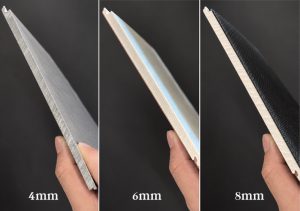
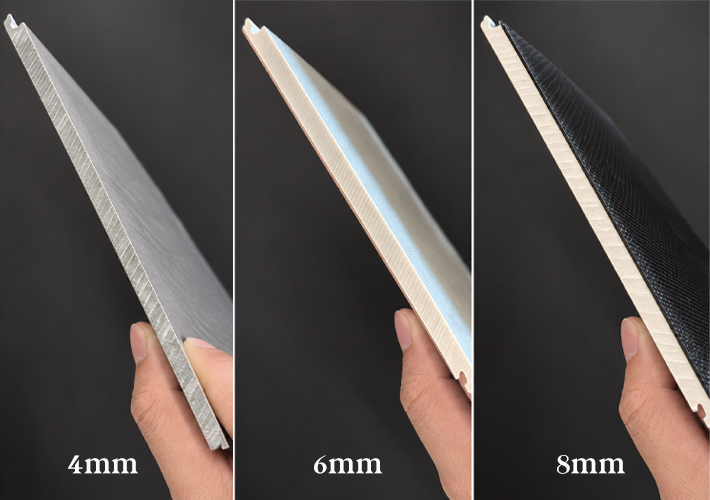
When buyers compare SPC flooring samples, total thickness is usually one of the first numbers they notice. A 4mm plank can look economical, a 6mm plank can appear balanced, and an 8mm plank can feel more substantial in the hand. However, thickness alone does not determine whether a product is suitable for a particular order.
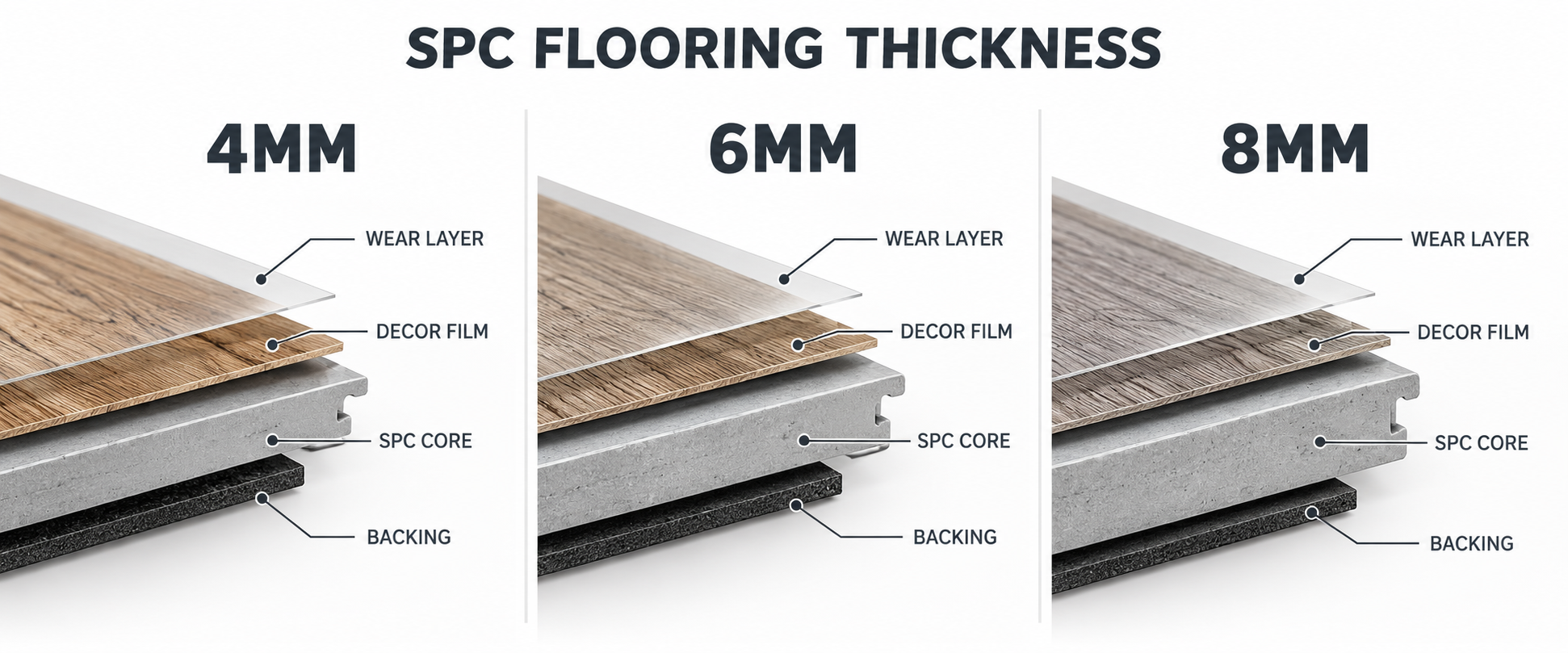
Total thickness includes several layers: the wear layer, printed film, rigid SPC core, and sometimes an attached underlayment. Two products with the same total thickness can therefore have different wear resistance, click performance, dimensional stability, and acoustic results. A thicker board can also add cost, weight, and clearance requirements without solving the buyer’s main problem.
For importers, distributors, wholesalers, and project purchasing teams, the better question is not “Which thickness is best?”It is “Which combination of thickness, construction, and test performance matches the order?”This guide compares 4mm, 6mm, and 8mm SPC flooring so buyers can request samples and quotations with clearer technical criteria.
How SPC flooring thickness is built up
Before comparing numbers, ask the manufacturer to break total thickness into layers. A typical rigid SPC product may include:
- Wear layer: The transparent protective layer that supports abrasion and scratch resistance.
- Decorative film: The printed wood, stone, or other visual pattern.
- SPC core: The rigid stone-polymer composite layer that provides most of the board’s structure.
- Balance or backing layer: A stabilizing layer below the core.
- Attached underlayment: Optional IXPE, EVA, or another backing layer that may be included in the advertised total thickness.
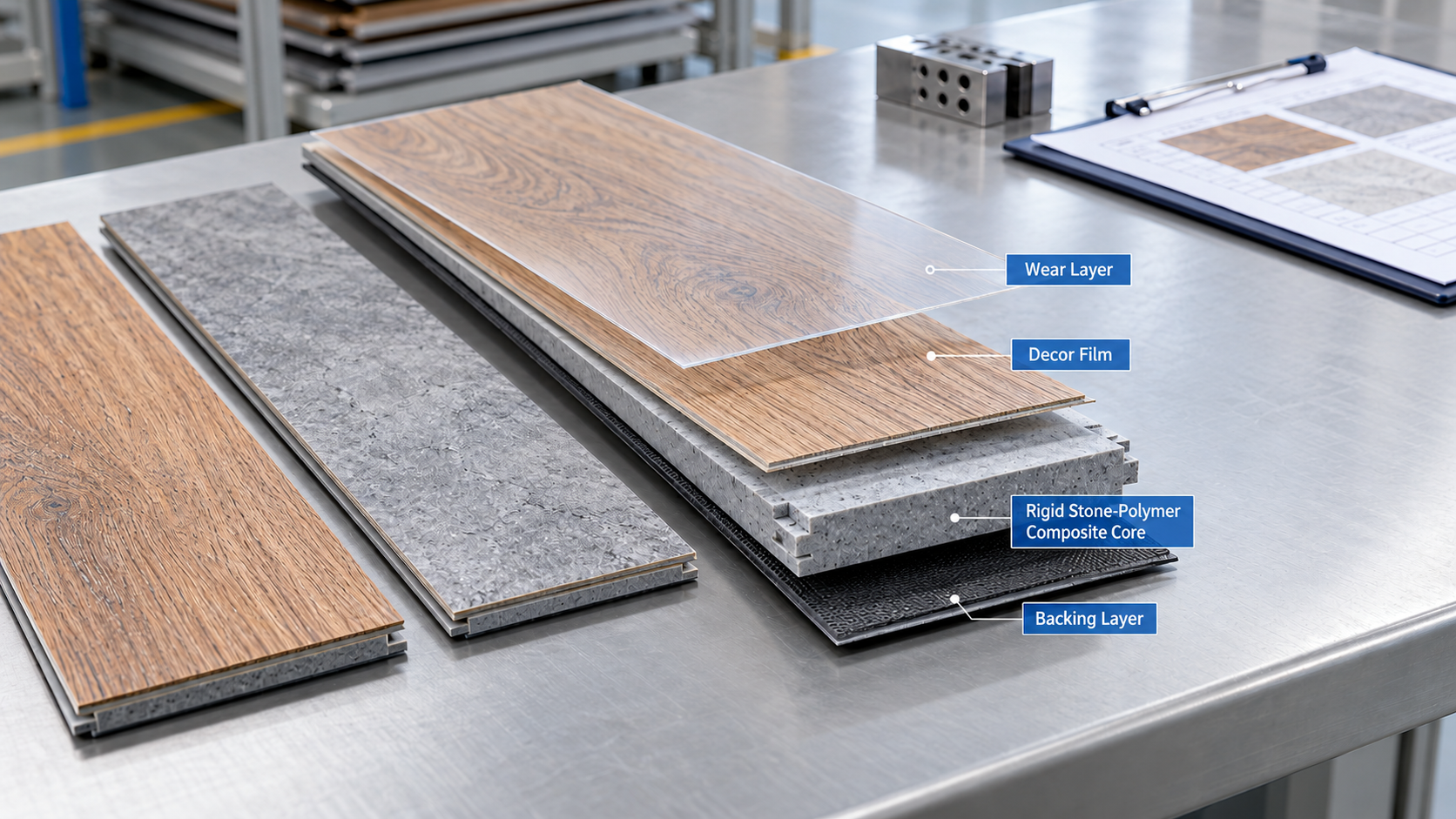
If a quotation says “6mm SPC flooring,”confirm whether that means 6mm including the attached pad or 6mm rigid board plus a separate underlayment. This distinction affects door clearance, carton calculations, installation details, and comparisons between suppliers.
It is also important to confirm how thickness is measured. The buyer and factory should use the same measurement points and the same tolerance method. A product should not pass a thickness requirement simply because one edge or one isolated location meets the target.
4mm SPC flooring: a lighter specification for controlled conditions
4mm SPC flooring is often selected when the order needs a lighter board, a lower material cost, or easier transitions to adjacent finishes. It can be a practical option when the subfloor is already flat and stable, the product construction is well controlled, and the buyer has confirmed that the click profile and core density meet the project requirements.
Potential advantages of 4mm
- Lower material weight and potentially lower freight weight per square meter
- Easier coordination with existing floor heights and door clearances
- More efficient use of raw materials when the performance specification does not require a thicker core
- Competitive pricing for buyers who need a defined, cost-conscious specification
Points to verify before ordering 4mm
The thinner core leaves less room to absorb a poor subfloor. It does not mean that every 4mm product is weak, but it does make flatness, density, click geometry, and installation conditions more important. Request the actual core thickness, total thickness, wear-layer thickness, and tolerance rather than relying on a product name.
For a 4mm sample, check whether the plank flexes excessively, whether the click connection closes evenly, and whether the long edges remain aligned after several pieces are assembled. These simple checks do not replace laboratory testing, but they can reveal a mismatch between the quotation and the physical sample.
6mm SPC flooring: a balanced specification for many orders
6mm SPC flooring is commonly considered a middle-ground specification. It provides more core material than a lightweight 4mm construction while usually remaining easier to handle and quote than a thicker 8mm board. The balance can be useful when a buyer wants a more substantial plank without making thickness the main cost driver.
Potential advantages of 6mm
- A more substantial feel during handling and installation
- More tolerance for normal variation in the prepared subfloor than a very thin board
- Room to combine a rigid core with a practical wear layer and attached pad
- A specification that is often easier to position across different price tiers
Points to verify before ordering 6mm
Do not assume that moving from 4mm to 6mm automatically doubles durability. The wear layer, core formulation, density, locking system, and dimensional stability still matter. If two 6mm products have different wear-layer thicknesses or pad constructions, their real-world performance and pricing may differ significantly.
For a 6mm order, ask the factory to state the layer build-up in the technical data sheet. For example, the document should distinguish between rigid plank thickness and attached underlayment thickness. This makes it easier to compare offers and prevents a supplier from using a thicker pad to create a higher total-thickness number without improving the core.
8mm SPC flooring: a heavier, more substantial construction
8mm SPC flooring is selected when the buyer wants a thicker rigid board, a more substantial underfoot feel, or a product positioned toward a higher specification. It can provide useful design and handling advantages, but it also increases material usage, carton weight, and the need to confirm transition details.
Potential advantages of 8mm
- A more substantial plank profile and underfoot feel
- More space for a robust rigid-core construction and integrated backing system
- A premium specification for buyers who want thickness to support product positioning
- Potentially improved acoustic results when the complete backing construction is designed well
Points to verify before ordering 8mm
An 8mm board is not automatically more stable, more abrasion-resistant, or better at handling moisture. Those results depend on the formulation and manufacturing controls. A thick board with poor click geometry or inconsistent dimensions can still create installation complaints.
Also check practical constraints. The finished floor may sit higher than a 4mm or 6mm alternative, which can affect doors, transitions, skirting, stair nosings, and connections to other floor finishes. Ask for the complete installed thickness, including the attached pad if there is one.
4mm vs 6mm vs 8mm: a buyer’s comparison
| Factor | 4mm SPC flooring | 6mm SPC flooring | 8mm SPC flooring |
|---|---|---|---|
| Material use | Lower | Moderate | Higher |
| Handling weight | Lighter | Medium | Heavier |
| Floor-height impact | Easier to coordinate | Moderate | Requires closer clearance checks |
| Subfloor sensitivity | Higher | Moderate | Still requires a properly prepared subfloor |
| Product positioning | Cost-conscious or lightweight | Balanced specification | More substantial or premium specification |
| Main inspection focus | Flatness, click fit, core consistency | Layer build-up, click fit, stability | Dimensions, weight, transitions, click strength |
| Key warning | Do not use thickness to compensate for poor subfloor preparation | Do not compare total thickness without layer details | Do not assume thickness alone creates durability |
This table is a starting point, not a substitute for the approved sample and technical data sheet. The correct specification depends on the product design, buyer requirements, destination standards, and installation system.
Thickness is only one part of the technical specification
When requesting an SPC flooring quotation, evaluate thickness together with the following factors.
Wear-layer thickness
Ask whether the wear layer is 0.3mm, 0.5mm, 0.7mm, or another value, and confirm the measurement method. A thicker core does not replace a wear layer that is unsuitable for the buyer’s expected service conditions.
Core density and formulation
Core consistency affects rigidity, screw or indentation behavior, click stability, and dimensional performance. Request the manufacturer’s stated density range and the relevant test reports where required by the order.
Plank dimensions and tolerance
Length, width, thickness, squareness, straightness, and joint alignment should be checked against the purchase specification. Small dimensional differences can become visible across a large installed area.
Click profile and assembly
Assemble multiple planks from different cartons. Check whether the joint closes without excessive force, whether the surface remains level, and whether the connection opens or chips during normal handling.
Attached underlayment
Confirm the pad material, thickness, density, adhesion, and whether it is included in the quoted total thickness. An attached pad can change acoustic performance and floor height, but it should not obscure the rigid-board specification.
Packaging and carton weight
The thickness affects square meters per carton, carton weight, pallet quantity, and container loading. Ask for the final packing list before shipment so the logistics plan is based on the production specification rather than an early estimate.
A pre-order checklist for buyers
Before approving 4mm, 6mm, or 8mm SPC flooring, put the following information in writing:
- Total thickness and rigid-core thickness
- Wear-layer thickness and surface finish
- Plank length, width, and dimensional tolerances
- Core density range and stability requirements
- Click-system sample and assembly instructions
- Attached underlayment material and thickness, if included
- Applicable abrasion, dimensional-stability, fire, slip, VOC, or other test requirements
- Carton quantity, carton weight, pallet details, and loading plan
- Approved color, embossing, gloss level, and packaging artwork
- Inspection method, sampling level, acceptance criteria, and photo records before shipment
The specification should match the approved sample. If the factory changes the core, backing, click profile, surface treatment, or packing configuration, the buyer should review the change before mass production continues.
How ChangFlor can support a thickness-based specification
At ChangFlor, buyers can use the sample stage to compare construction details before confirming a bulk order. A practical process is to start with the target thickness, define the required wear layer and surface finish, confirm the complete layer build-up, and then review the technical data and packing information.
If you are comparing 4mm, 6mm, and 8mm options, send us your target plank size, wear-layer requirement, locking system, quantity, packaging needs, and destination market. We can help you evaluate the specification, prepare samples, and confirm the details that should be checked before shipment.
For a sample request, visit Free Sample. For a quotation or technical discussion, contact the ChangFlor team through Contact Us.
FAQ about SPC flooring thickness
Is 8mm SPC flooring always better than 4mm?
No. 8mm provides a thicker construction, but product quality also depends on the wear layer, core density, click profile, dimensional stability, and backing system. Choose the complete specification rather than the highest thickness number.
Does thicker SPC flooring need a thicker underlayment?
Not necessarily. The correct underlayment depends on the product design, subfloor, acoustic requirement, and installation instructions. Confirm whether the quoted thickness already includes an attached pad.
Can 4mm SPC flooring be used for a bulk order?
It can be appropriate when the product specification and installation conditions support it. Buyers should pay particular attention to subfloor flatness, click fit, core consistency, and the approved sample.
What is the most important question to ask a manufacturer?
Ask the manufacturer to show the complete layer build-up and to state the tolerance for each key dimension. This makes a 4mm, 6mm, or 8mm quotation easier to compare on a like-for-like basis.
Should the buyer inspect thickness before shipment?
Yes. Thickness should be checked together with length, width, squareness, surface quality, click fit, packaging, and documentation. The final inspection should follow the agreed purchase specification and sampling plan.
Final takeaway
4mm, 6mm, and 8mm SPC flooring each serve a different specification and price strategy. A lighter 4mm board may simplify floor-height coordination, 6mm can provide a balanced construction, and 8mm can support a more substantial product position. None of these numbers is a guarantee of quality by itself.
The safest buying decision comes from comparing the complete layer structure, performance data, approved sample, and shipment inspection requirements. When those details are clear, thickness becomes a useful purchasing tool instead of a misleading headline number.