
Buying SPC flooring from a Chinese manufacturer is not finished when the production line is complete. The most important quality decision often happens just before shipment, when you can still ask the factory to correct a problem, replace damaged cartons, or hold a container until the order matches the approved sample.
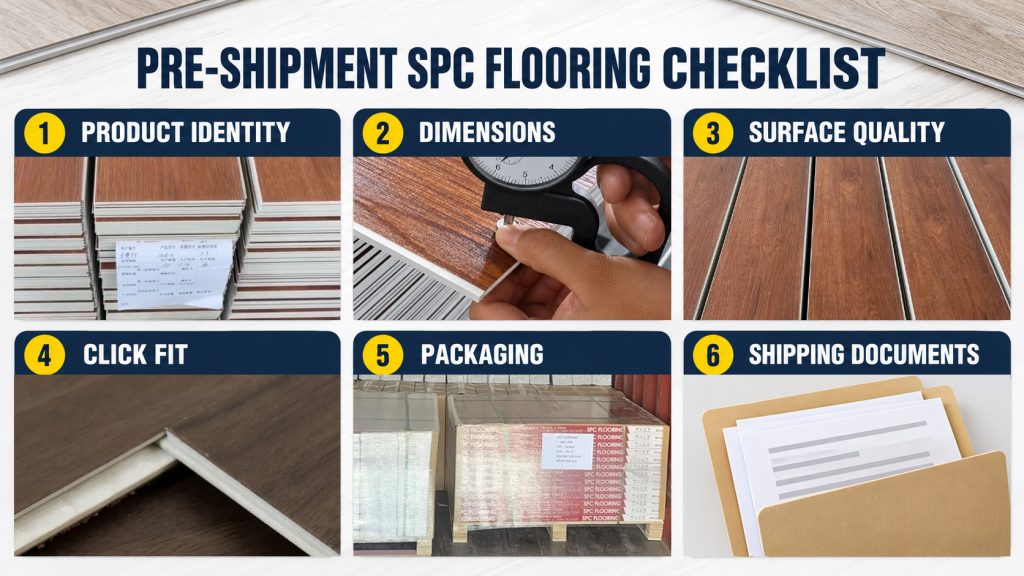
Six core checks to complete before approving an SPC flooring shipment.
This SPC flooring quality inspection checklist is designed for importers, distributors, wholesalers, and project purchasing teams. It focuses on the checks that can be confirmed from the production batch, packaging, and factory documents before the goods leave China.
Why a pre-shipment inspection matters
An approved sample is a reference, not a guarantee that every production carton will be identical. Small changes in raw materials, printing, pressing conditions, tooling, or packing can affect the finished flooring. A pre-shipment inspection gives the buyer a documented opportunity to compare the batch against the purchase order and approved sample.
The goal is not to inspect every plank one by one. A practical inspection combines a defined sampling plan, objective acceptance criteria, visual checks, dimensional measurements, performance documents, and photographs. The exact inspection level should match the order value, product risk, and requirements of the destination market.
1. Confirm the product identity and purchase-order details
Start with the information that identifies the order. Before testing the product, confirm that the cartons and inspection samples belong to the correct SKU and production batch.
Check:
- Product name, collection, color, and SKU
- Plank length, width, and nominal thickness
- Wear-layer specification and surface finish
- Click profile or installation system
- Quantity produced, packed, and ready to ship
- Purchase-order number, batch number, and production date
- Approved sample or signed color reference
If the factory has several similar colors or thicknesses in production, photograph the carton label and product label together. This simple record helps prevent a correct inspection report from being attached to the wrong SKU.
2. Measure plank length, width, and thickness
Dimensional consistency affects installation, pack coverage, joint appearance, and the buyer’s inventory calculations. Measurements should be taken from samples selected from different cartons and, where practical, from different pallets.
Use calibrated tools and record:
- Overall length and width
- Total thickness
- Wear-layer thickness, if the inspection equipment can measure it reliably
- Edge straightness and squareness
- Number of planks checked and the result for each sample
Do not rely on one plank from one carton. A batch can look consistent at the top of a pallet while containing variation elsewhere. Ask the factory to explain any measurement outside the agreed tolerance before the goods are packed for export.
3. Check the SPC core and layer construction
SPC flooring is a layered product. The visual surface may look correct while an internal layer or core issue creates problems later. The inspection should compare the production cross-section or technical data with the approved construction.
Confirm, where applicable:
- SPC core composition and nominal thickness
- Stability of the core and absence of visible voids
- Wear layer and UV coating construction
- Printed film alignment and repeat pattern
- Attached underlayment type and bonding
- Bevel, edge treatment, and click geometry
If a destructive sample is required, agree on the number of samples before inspection. The factory should provide the production specification and explain whether the sample will be replaced or deducted from the order.
4. Inspect the surface and decorative finish
Surface inspection should be performed under bright, even lighting. Inspect the plank face from several angles instead of checking only under the factory’s ceiling lights.
Look for:
- Scratches, dents, pinholes, stains, and contamination
- Uneven gloss or coating marks
- Blisters, bubbles, cracks, or peeling
- Printing defects, blurred grain, and repeated visual errors
- Color variation between planks and cartons
- Incorrect embossing or texture alignment
- Damaged bevels and chipped edges
Compare the production batch with the approved sample under the same lighting conditions. If color matching is critical, use a written reference, approved sample board, or agreed color tolerance rather than relying on a phone photograph.
5. Test click fit and joint appearance
Click-lock performance is best checked by assembling several production planks from different cartons. The aim is to identify fit problems before a distributor or installer discovers them on site.
Check whether:
- Planks lock together without excessive force
- The joint closes evenly along its full length
- The assembled surface is level and free of obvious lipping
- End joints remain aligned after assembly
- The click edge does not break during normal test assembly
- Disassembly, if required by the approved system, does not cause abnormal damage
Record the tools, method, and number of assemblies used. A single successful connection is not enough evidence for a large batch; take samples from multiple cartons and production positions.
6. Check flatness, warping, and edge condition
Lay samples on a known flat surface and inspect them from both ends. Check for bowing, twisting, corner lift, and edge deformation. These conditions can affect joint appearance and make later handling more difficult.
The acceptance limit should be agreed before inspection because the result depends on product construction, plank size, and the buyer’s quality standard. Record the measurement method, not just a statement such as “flatness is good.” Photographs with a straightedge or measuring tool provide stronger evidence.
7. Verify abrasion and other test documents
The inspection report should not replace laboratory testing. Ask the manufacturer to provide current test reports or quality records that match the actual product construction and color being purchased.
Depending on the product and destination market, the document package may include records related to:
- Abrasion or wear performance
- Dimensional stability
- Slip or surface characteristics
- Fire performance
- Emissions or indoor-air requirements
- Chemical or restricted-substance requirements
- Underlayment or adhesive compatibility, if supplied
Check the report date, tested product description, construction, laboratory identity, and whether the report applies to the current production specification. Do not assume that a certificate for one collection automatically covers every SKU.
8. Verify carton labels and packing information
Carton information must be consistent with the order, product, and shipping documents. A packaging error can create receiving delays even when the flooring itself is acceptable.
Confirm:
- SKU, color name, and shade or lot reference
- Planks per carton and square metres or square feet per carton
- Carton and pallet quantity
- Net and gross weight, when specified
- Batch or production identification
- Handling marks and orientation marks
- Buyer artwork, barcode, and language requirements
Measure a finished carton if freight planning depends on final dimensions. Photograph labels from several cartons, not only the first carton prepared for inspection.
9. Inspect carton strength and pallet protection
Packaging is part of product quality. The factory should demonstrate that the cartons and pallets can protect the flooring through loading, transport, unloading, and warehouse handling.
Inspect:
- Carton board strength and seam condition
- Corner protection and edge protection
- Internal separators or protective film
- Pallet stability and stacking pattern
- Stretch film, straps, and moisture protection
- Visible crushing, water marks, or punctures
If the buyer has a history of transit damage, use the inspection to review the loading method and container photos as well as the finished cartons. Packaging improvements are usually easier to make before loading than after a claim is filed.
10. Reconcile quantity, assortment, and loading plan
Count or verify the packed quantity by SKU, color, and carton count. The total quantity should reconcile with the purchase order, packing list, and commercial invoice draft.
Pay particular attention to:
- Mixed-color pallets
- Partial cartons
- Replacement cartons
- Short shipments or overages
- Cartons held for rework
- Product loaded in a different sequence from the packing list
For mixed containers, request a clear pallet map or loading list. It reduces receiving time and helps the buyer locate a specific batch if a quality issue is reported later.
11. Review the inspection record and non-conformance process
A useful inspection report should identify what was checked, how it was checked, and what happens if the result is not acceptable. Ask the factory or inspection company to document defects by type and severity.
The report should include:
- Inspection date and location
- Inspector name or inspection company
- SKU and batch number
- Sampling method and sample size
- Defect photographs and defect counts
- Dimensional measurements
- Document references
- Accepted, rejected, or conditional status
- Corrective-action deadline and reinspection plan
Do not approve a shipment only because the supplier says the problem will be fixed. Require evidence of correction, such as new photographs, replacement-carton counts, or a follow-up inspection.
12. Confirm the final shipping document package
Before release, make sure the document set is complete and consistent. The exact documents depend on the contract, destination, Incoterms, and buyer’s compliance requirements, but the final package commonly includes:
- Commercial invoice
- Packing list
- Bill of lading or shipping instructions
- Certificate of origin, when required
- Product specification sheet
- Test reports or compliance documents
- Inspection report
- Loading photographs
- Approved sample or color reference record
Check that the product name, quantity, carton count, weights, and batch information agree across the documents. Inconsistent descriptions can cause customs, receiving, or internal approval problems.
A practical acceptance checklist
Before approving shipment, ask these questions:
| Check | Evidence to keep | Result |
|---|---|---|
| Product identity | SKU, color, batch, approved sample | Pass / Hold |
| Dimensions | Measurement sheet and sample count | Pass / Hold |
| Surface quality | Photos and defect record | Pass / Hold |
| Layer construction | Specification and sample evidence | Pass / Hold |
| Click fit | Assembly photos and method | Pass / Hold |
| Flatness and edges | Measurement record | Pass / Hold |
| Test documents | Current reports for the actual SKU | Pass / Hold |
| Carton labels | Label photos and packing list | Pass / Hold |
| Packaging strength | Carton and pallet photos | Pass / Hold |
| Quantity | Count by SKU and carton | Pass / Hold |
| Corrective actions | Closure evidence or reinspection | Pass / Hold |
| Shipping documents | Final matched document set | Pass / Hold |
What to do when the batch does not pass
If the result is not acceptable, separate the issue into three decisions:
1. Can the problem be corrected? Examples include relabelling, replacing cartons, reworking a small quantity, or repacking damaged pallets. 2. Does the buyer need a new inspection? A verbal correction is not enough for a material defect or a large batch. 3. What is the commercial impact? The buyer may need a replacement, credit, price adjustment, partial shipment, or revised delivery date.
Put the agreed solution in writing and link it to the SKU, batch, quantity, and deadline. Keep the original inspection report together with the corrective-action record so the final approval history is complete.
How a manufacturer can make inspection easier
The best inspections are prepared before production starts. Share the purchase order, approved sample, tolerance requirements, packaging artwork, target-market documents, and inspection checklist with the manufacturer early. This gives the factory a clear quality target and reduces disagreement at the end of production.
ChangFlor can support buyers with SPC flooring samples, product specification review, packaging coordination, production communication, and pre-shipment quality documentation. If you are comparing suppliers or preparing a new order, request a sample and discuss the inspection requirements before confirming production.
FAQ
Should I inspect every carton of SPC flooring?
Usually, a defined sampling plan is more practical than opening every carton. The sampling level should reflect the order value, product risk, past supplier performance, and the buyer’s agreed acceptance criteria. High-risk or customized orders may justify a larger sample or additional inspection stages.
When should the inspection take place?
For a pre-shipment inspection, the product should be substantially complete and packed, with enough cartons available for representative sampling. If the order is large or customized, consider an earlier production-line or first-article check as well.
Can a test report replace a physical inspection?
No. A test report can provide evidence about a specific performance requirement, but it does not confirm the current batch’s color, surface condition, dimensions, carton labels, quantity, or transit packaging. Documents and physical inspection serve different purposes.
What should I send to a factory before requesting a quotation?
Send the target construction, dimensions, wear layer, surface finish, colors, packaging requirements, expected quantity, destination-market documents, and preferred inspection criteria. Clear requirements help the factory quote the same product that will later be inspected.
Final takeaway
An SPC flooring quality inspection should connect the approved sample, purchase order, production batch, physical product, packaging, and shipping documents. When these records agree, the buyer has a much stronger basis for approving shipment and managing the order after arrival.
For a customized SPC flooring quotation or sample request, contact ChangFlor before your next order.