
Buying SPC flooring from China is easier to manage when every important product and shipment detail is documented before the purchase order is confirmed. A quotation may show a price, quantity, and delivery term, but it does not always explain exactly what will be produced, packed, inspected, and shipped.
For importers, distributors, flooring brands, contractors, and project buyers, the right document set creates a shared reference between the buyer and the factory. It helps prevent specification changes, reduces misunderstandings during production, and makes repeat orders easier to control.
This guide explains the main documents to request from an SPC flooring manufacturer before ordering, what each document should contain, and which warning signs deserve a closer review.
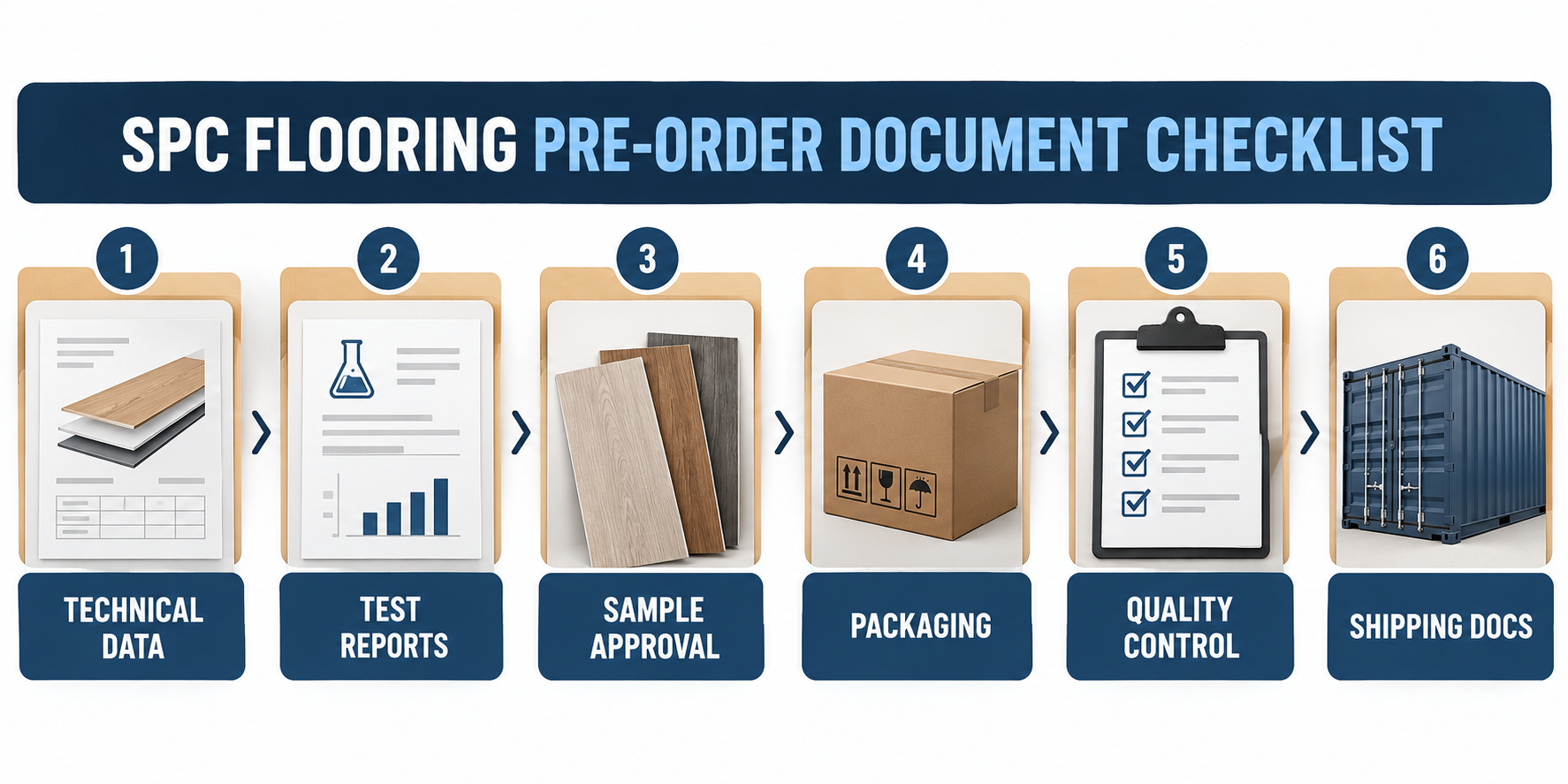
1. Product Technical Data Sheet
Start with a product technical data sheet for the exact SPC flooring model you intend to purchase. The document should identify the product clearly rather than using only a broad description such as “waterproof vinyl flooring.”
Ask the manufacturer to list:
- Product name, model number, and product type
- Plank or tile dimensions and tolerances
- Overall thickness and wear-layer thickness
- Core construction and backing or attached pad details
- Surface finish, embossing, and decorative pattern
- Installation system, such as click-lock or another specified format
- Carton quantity, coverage per carton, and pallet information
- Recommended storage and handling conditions
The data sheet should match the product sample, quotation, and purchase order. If the dimensions or construction change after the quotation stage, ask for a revised document and keep the approved version in your order file.
2. Construction and Wear-Layer Specifications
SPC flooring is a layered product. A short product name does not tell a buyer enough about the core, decorative film, wear layer, surface treatment, or backing. Request a clear layer description or technical cross-section when the order requires a specific performance level.
Confirm the following points in writing:
Core and total thickness
The core formulation and total thickness influence the product’s rigidity, dimensional behavior, and installation requirements. The approved thickness should be stated in the technical document and reflected in the production sample.
Wear layer
The wear layer should be listed as a measurable specification, not only as “commercial grade” or “high wear resistance.” Ask the supplier to confirm the agreed thickness and the test method used for any wear-related result.
Surface and finish
Surface texture, coating, gloss level, and embossing can affect appearance, cleaning expectations, and visual consistency between batches. If the project depends on a particular wood grain, stone pattern, or matte finish, record the approved sample or reference code.
Dimensions and tolerances
Nominal dimensions alone are not enough for large orders. Ask how dimensional tolerance, squareness, thickness variation, and click-lock fit are controlled. These details are particularly important when the flooring will be installed across multiple rooms or supplied repeatedly to the same market.
3. Test Reports and Compliance Documents
Request test reports that are relevant to the product, destination market, and intended sales channel. A report from a laboratory is useful only when the tested sample and test scope correspond to the flooring being quoted.
Review each report for:
- Product name or model tested
- Sample description and date of testing
- Laboratory name and report number
- Test standard or method
- Measured result and conclusion
- Report validity or issue date, when applicable
Depending on the destination and buyer requirements, the document package may include testing related to wear, dimensional stability, slip performance, fire behavior, emissions, or other requested properties. Do not assume that one general certificate covers every market or every SPC construction.
If a buyer needs a specific compliance document, state that requirement before production begins. The manufacturer should confirm whether the document is available for the exact product, whether a new test is needed, and whether the buyer’s destination country has additional requirements.
4. Sample Approval and Color Confirmation Records
The approved sample is one of the most important records in a flooring order. Product names and digital images can leave too much room for interpretation, especially when the design includes several tones, grain directions, or surface textures.
Keep a record of:
- Sample shipment date and tracking details
- Model number and decorative film reference
- Approved color, surface, edge, and finish
- Plank or tile dimensions shown in the sample
- Buyer comments and approval date
- Any approved changes to the sample
For custom designs or private-label orders, create a simple sample approval sheet that includes photographs and a written description. The final document should make clear which sample is the production reference and whether the buyer approved a physical sample, a digital proof, or both.
5. Packaging Details, Carton Marks, and Loading Information
Packaging affects product protection, warehouse handling, carton labeling, and shipping calculations. Request packaging information before the final order quantity is fixed.
The packaging document should confirm:
- Pieces per carton and square meters or square feet per carton
- Carton dimensions and gross or net weight
- Cartons per pallet, if pallets are used
- Pallet dimensions and wrapping method
- Carton marks, product labels, and barcode requirements
- Container loading assumptions
- Handling symbols and storage instructions
Ask the supplier to confirm whether the packing quantity can change because of the selected dimensions or special packaging. Even a small change in coverage per carton can affect the total quantity, container utilization, and customer pricing.
For private-label orders, approve the artwork and carton marking separately. The approved artwork should be linked to the model number and purchase order so that old packaging files are not used by mistake.
6. Quality-Control and Pre-Shipment Inspection Records
Before production, agree on what the factory will check and how exceptions will be handled. A quality-control document does not need to be complicated, but it should identify the inspection points that matter to the order.
A practical inspection checklist can include:
- Product model, color, and surface consistency
- Dimensions, thickness, and visual defects
- Wear-layer or construction confirmation
- Click-lock or edge fit, when relevant
- Carton quantity and label accuracy
- Packaging condition and pallet stability
- Random carton inspection and photographs
- Quantity produced versus quantity ordered
Request production or pre-shipment photographs when they are part of your purchasing process. For larger or repeat orders, buyers may also define an independent inspection requirement, sampling level, or acceptance standard in advance.
The key is to connect the inspection result to the approved technical data and sample. A report that says “passed” without identifying the product or criteria is difficult to use in a dispute.
7. Commercial Invoice, Packing List, and Shipping Documents
Once production is complete, the export document set should match the commercial terms and the physical shipment. Confirm the information before the container is released or the documents are finalized.
Common documents may include:
- Commercial invoice
- Packing list
- Bill of lading or other transport document
- Certificate of origin, when required
- Insurance document, when applicable
- Export or customs information required by the buyer’s broker
Check the product description, model number, quantity, carton count, weights, dimensions, consignee details, and shipping terms. The exact document requirements can vary by destination, transport mode, and commercial arrangement, so the buyer should confirm them with the customs broker, freight forwarder, or import adviser.
The manufacturer should not be expected to guess a destination’s import requirements. Share the required company and shipping information early, then compare the draft documents with the purchase order before shipment.
8. Documents to Keep for Repeat Orders
A well-organized document file is valuable after the first shipment. When you reorder the same SPC flooring, compare the new documents with the previous approved version instead of relying on memory.
Keep the following together:
- Approved technical data sheet
- Approved physical sample photographs
- Test reports and compliance records
- Packaging artwork and carton marks
- Quality-control checklist and inspection photos
- Purchase order and quotation
- Final invoice, packing list, and shipping documents
- Written records of any approved change
This history helps the buyer identify differences in thickness, packaging, design, or labeling before the new order is produced. It also gives the manufacturer a clearer reference for repeat production.
9. Red Flags in Incomplete Supplier Documents
Be careful when a supplier provides documents that are difficult to connect to the quoted product. Common warning signs include:
- A test report with no matching model number
- Different thicknesses shown on the quotation and data sheet
- Generic certificates with no product description
- Packaging quantities that do not match the invoice
- Sample colors described only as “similar” without approval records
- Inspection reports with no inspection date or acceptance criteria
- Repeated changes to specifications without a revised purchase order
These issues do not automatically prove that a supplier is unsuitable, but they should be resolved before the order is released. Ask focused questions and request corrected documents rather than relying on informal messages alone.
10. Final Pre-Order Document Checklist
Before approving an SPC flooring order from China, confirm that you have:
- The exact model and technical data sheet
- The agreed construction, thickness, wear layer, and dimensions
- Relevant test or compliance documents for the destination market
- A physical sample or documented design approval
- Confirmed carton, pallet, label, and loading information
- A quality-control and inspection plan
- The required commercial and shipping document list
- A written process for approving product or packaging changes
The purpose of this checklist is not to create unnecessary paperwork. It is to make the product scope visible before money, production capacity, and shipping space are committed.
Conclusion
The most reliable SPC flooring orders are supported by a clear document trail. Technical data confirms what the factory should produce. Samples and approval records confirm what the buyer expects to receive. Packaging, quality-control, and shipping documents connect the finished goods to the shipment that arrives at the warehouse.
If you are comparing Chinese SPC flooring manufacturers, send your target dimensions, wear layer, quantity, packaging requirements, destination, and required documents before requesting a final quotation. ChangFlor can help buyers review product details, arrange samples, prepare specifications, and discuss factory-direct supply for repeat or private-label orders.
Need a document-ready SPC flooring quotation? Request a free sample or contact our flooring team with your product brief.