Introduction
Flooring design is becoming increasingly important in residential, commercial, hospitality, and office construction projects. Buyers are no longer looking only for durable flooring materials. They also want products that combine attractive visual effects, practical performance, easy maintenance, and competitive long-term costs. One product category attracting growing interest is waterproof carpet look SPC flooring.
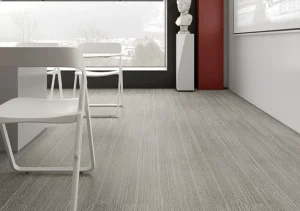
Waterproof carpet look SPC flooring combines the decorative appearance of carpet with the structural advantages of Stone Plastic Composite (SPC) flooring. It offers a practical alternative for buyers who appreciate the warm, textured appearance of carpet but need a flooring solution that is easier to clean, more resistant to moisture, and suitable for demanding environments.
Unlike traditional textile carpets, SPC flooring is manufactured with a rigid mineral-based core, a decorative printed layer, and a protective wear layer. Advanced printing technology can reproduce carpet-inspired patterns, woven textures, geometric designs, and subtle fabric-like visual effects while retaining the practical characteristics of rigid vinyl flooring.
For flooring importers, wholesalers, distributors, and project contractors, carpet look SPC flooring creates opportunities to serve customers who want the visual comfort of carpet without accepting some of its maintenance limitations.
However, not all carpet look SPC flooring products offer the same quality. Core density, wear layer thickness, surface texture, locking system, dimensional stability, and decorative consistency all influence the final product’s performance.
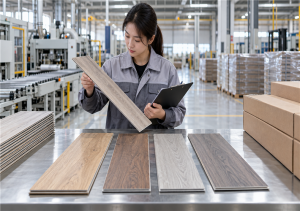
As a professional Chinese flooring manufacturer, Changflor supplies SPC and LVT flooring solutions for international wholesale and commercial project markets. Understanding the following product characteristics and purchasing considerations can help buyers select suitable specifications, evaluate suppliers, and make more informed bulk purchasing decisions.
What Is Waterproof Carpet Look SPC Flooring?
Waterproof carpet look SPC flooring is a type of rigid-core vinyl flooring designed to imitate the appearance of traditional carpet while maintaining the structural characteristics of SPC flooring.
The term “carpet look” refers to the decorative surface design rather than an actual textile carpet construction. Instead of woven fibers, nylon yarn, polyester piles, or other textile materials, the surface uses a printed decorative film protected by a transparent wear layer.
This manufacturing approach allows flooring producers to create different carpet-inspired appearances without using conventional carpet fibers.
1.1 Understanding the SPC Flooring Structure
SPC stands for Stone Plastic Composite or Stone Polymer Composite. It is a rigid-core flooring material generally manufactured using calcium carbonate, PVC resin, and processing additives.
A typical waterproof carpet look SPC flooring product consists of several layers:
1. UV Coating Layer
The UV coating is applied to the top surface to improve resistance to everyday stains, dirt, and surface wear. Depending on the coating formulation, it can also help maintain the appearance of the decorative surface and make routine cleaning easier.
2. Wear Layer
The transparent wear layer protects the decorative film from abrasion, scratches, and daily foot traffic. Its thickness is one of the most important specifications when selecting SPC flooring for different applications.
Common commercial specifications include 0.3 mm and 0.5 mm wear layers, while some product ranges offer other thickness options.
3. Decorative Film Layer
This layer determines the visual appearance of the flooring. For carpet look SPC flooring, the decorative film reproduces textile-inspired patterns, woven textures, geometric arrangements, and carpet-style color combinations.
High-resolution printing technology allows manufacturers to produce detailed designs that resemble commercial carpet tiles or patterned textile flooring.
4. SPC Rigid Core Layer
The rigid core is the main structural component. It provides dimensional stability, rigidity, and resistance to moisture absorption.
Unlike traditional carpet backing, the SPC core does not contain textile fibers that can absorb spilled liquids and retain moisture.
5. Optional IXPE or EVA Underlay
Some SPC flooring products include an attached underlay made from IXPE or EVA foam.
This backing can improve underfoot comfort, reduce certain types of impact noise, and simplify installation by eliminating the need for a separate underlay in suitable applications.
The actual acoustic performance depends on the complete floor assembly, including the subfloor, underlay, and surrounding construction.
1.2 How Is Carpet Look SPC Different from Traditional Carpet?
Traditional carpet and carpet look SPC flooring may create similar visual impressions, but their construction and maintenance requirements are very different.
| Comparison | Traditional Carpet | Carpet Look SPC Flooring |
|---|---|---|
| Main material | Textile fibers | PVC and mineral-based rigid core |
| Surface | Woven or tufted fibers | Printed decorative film |
| Water resistance | Depends on fiber and backing | Waterproof SPC core |
| Cleaning | Vacuuming and periodic deep cleaning | Sweeping and damp mopping |
| Moisture absorption | Fibers and backing may absorb moisture | Rigid core has low water absorption |
| Installation | Stretch-in, glue-down, or carpet tiles | Usually click-lock or glue-down, depending on design |
| Surface texture | Real textile fibers | Printed or embossed surface |
| Maintenance | More intensive | Generally easier |
| Visual options | Colors, yarns, and patterns | Digital and printed decorative designs |
For buyers serving offices, hotels, retail spaces, and residential renovation markets, this distinction is important.
Carpet look SPC flooring is not intended to reproduce every tactile characteristic of real carpet. Instead, it offers a combination of carpet-inspired aesthetics and rigid vinyl flooring functionality.
1.3 Why Are Buyers Interested in Carpet-Inspired SPC Designs?
Several market requirements explain the appeal of this flooring category.
First, commercial interiors increasingly use different flooring appearances to define functional areas. A meeting room may require a warm, carpet-inspired visual effect, while an adjacent corridor needs a more practical hard-surface flooring solution.
Second, maintenance costs are an important consideration for hotels, offices, and property management companies. Traditional carpet may require specialized cleaning equipment and more frequent deep-cleaning procedures.
Third, buyers increasingly prefer flooring products that combine decorative flexibility with practical installation systems.
For importers and wholesalers, carpet look SPC flooring can expand an existing SPC flooring collection beyond conventional wood grain, stone, and marble designs.
Key Features and Performance Advantages of Waterproof Carpet Look SPC Flooring
When evaluating waterproof carpet look SPC flooring, buyers should consider more than its decorative appearance. The actual value of the product comes from its material structure, protective surface, dimensional stability, and suitability for different environments.
The following features explain why carpet-inspired SPC flooring can be a competitive option for residential and commercial flooring projects.
2.1 Waterproof Core for Better Moisture Resistance
One of the main advantages of SPC flooring is its mineral-based rigid core.
Traditional textile carpet can absorb water through its fibers and backing materials. When liquid penetrates deeply into the carpet structure, drying and cleaning can become more complicated.
SPC flooring has a different construction. Its rigid core is designed to resist water absorption, making it suitable for areas where occasional spills and routine wet cleaning are expected.
Potential applications include:
- Hotel guest rooms and corridors.
- Office reception areas.
- Retail stores and shopping facilities.
- Apartment living rooms and bedrooms.
- Commercial meeting rooms.
- Educational and administrative buildings.
However, waterproof flooring does not automatically mean that the entire installed floor system is waterproof.
Water may still penetrate through expansion gaps, perimeter joints, transitions, or poorly sealed installation details. Subfloor moisture and standing water must also be managed appropriately.
For commercial projects, buyers should distinguish between a waterproof flooring material and a fully waterproof flooring installation.
2.2 Carpet-Inspired Designs Without Textile Fibers
The decorative appearance is another important selling point.
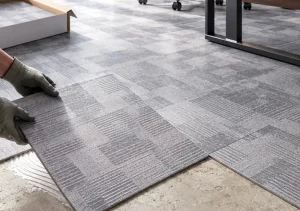
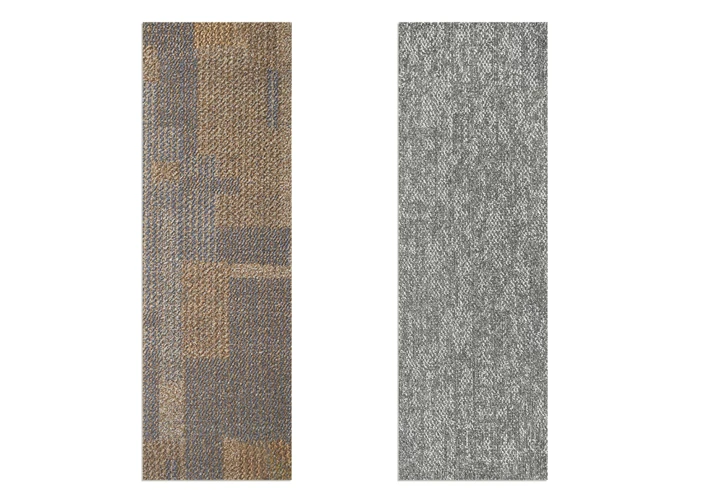
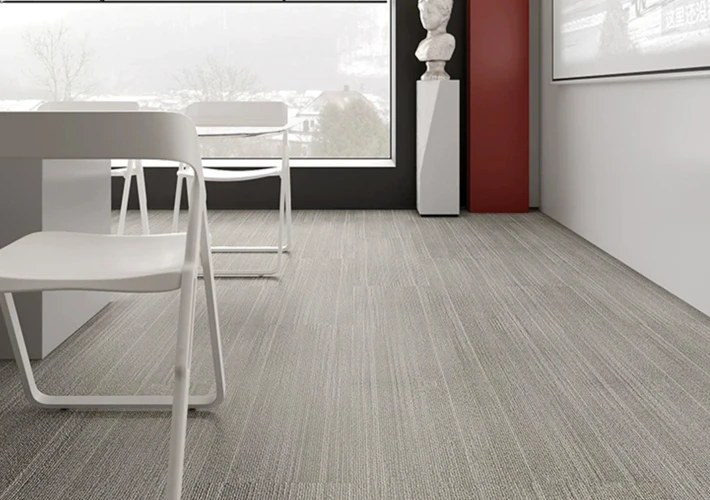
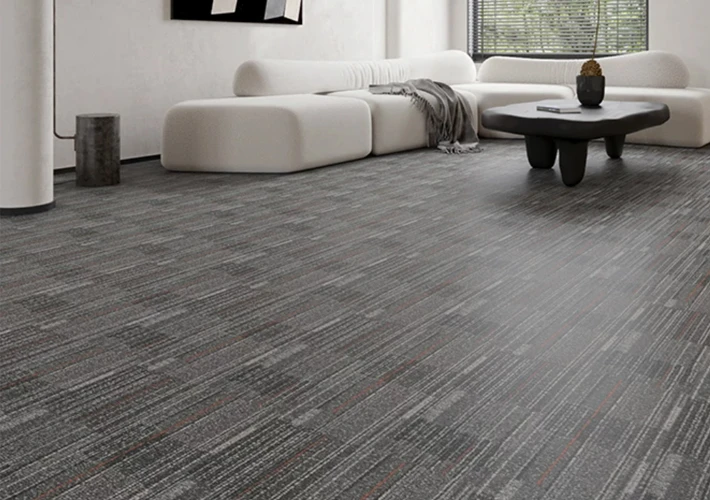
Modern printing technology allows manufacturers to reproduce a wide range of carpet-inspired patterns, including:
- Fine woven fabric patterns.
- Small geometric carpet designs.
- Linear textile textures.
- Commercial office carpet patterns.
- Multi-tone patterned surfaces.
- Contemporary abstract textile designs.
- Neutral-colored carpet effects.
These designs provide architects and interior designers with more options when developing coordinated commercial interiors.
For example, a hotel may use carpet-inspired SPC flooring in guest rooms to create a warm visual atmosphere while selecting wood-look SPC flooring for corridors and reception areas.
A retail project may combine different carpet-inspired colors to visually distinguish customer service zones, product display areas, and circulation spaces.
The advantage for distributors is that one product category can serve several interior design preferences without requiring a traditional textile flooring inventory.
2.3 Wear Resistance for Daily Commercial Traffic
Commercial flooring is exposed to repeated foot traffic, furniture movement, rolling office chairs, and regular cleaning.
The wear layer plays an important role in protecting the decorative surface.
For example:
- 0.2 mm wear layer: May be considered for selected light-duty residential applications, subject to the complete product specification.
- 0.3 mm wear layer: A common option for residential and certain moderate-traffic commercial applications.
- 0.5 mm wear layer: Often considered for busier commercial environments where greater surface protection is required.
- 0.7 mm wear layer: Available in some specialized product ranges for demanding applications.
These are purchasing guidelines rather than universal performance classifications. Actual suitability depends on the product construction, test results, installation conditions, and intended use.
Buyers should not evaluate wear resistance based only on the total thickness of the flooring. A 6 mm product with a relatively thin wear layer may not provide the same surface protection as a product with a thicker wear layer.
For wholesalers and project contractors, confirming wear layer thickness in the technical data sheet is essential.
2.4 Easy Cleaning and Lower Routine Maintenance
Carpet-inspired SPC flooring provides a hard, relatively smooth surface compared with traditional textile carpet.
This makes everyday cleaning more straightforward.
Routine maintenance generally includes:
- Removing loose dust and dirt with a vacuum cleaner or soft broom.
- Wiping the surface with a damp microfiber mop.
- Using a manufacturer-approved neutral cleaning solution when necessary.
- Removing spills promptly.
- Avoiding excessive water and harsh cleaning chemicals.
The flooring does not require conventional carpet shampooing or regular extraction cleaning.
This characteristic can be valuable for property management companies responsible for multiple hotel rooms, offices, or rental properties.
However, the surface should still be protected against abrasive dirt, sharp objects, and unsuitable cleaning chemicals.
2.5 Stable Rigid Core Construction
SPC flooring uses a rigid mineral-filled core that provides a firm structure.
Compared with some flexible vinyl flooring products, SPC flooring generally offers greater rigidity and can help maintain its shape under normal indoor service conditions when properly manufactured and installed.
Its performance depends on:
- Raw material formulation.
- Core density and consistency.
- Product thickness.
- Manufacturing temperature and pressure.
- Dimensional stability.
- Subfloor preparation.
- Installation quality.
For importers purchasing container quantities, dimensional consistency between production batches is particularly important.
A product that performs well in a small sample may still create installation problems if the factory cannot maintain consistent thickness, locking dimensions, and flatness during mass production.
2.6 Comfortable Appearance and Optional Acoustic Underlay
Although SPC flooring does not have the same soft pile structure as traditional carpet, it can create a visually warmer environment through its decorative patterns and colors.
Some products also feature an attached IXPE or EVA underlay.
This backing can help improve walking comfort and reduce certain impact sounds compared with installing rigid SPC flooring directly on a hard substrate.
Nevertheless, buyers should not assume that every SPC product has the same acoustic performance.
For hotel apartments, offices, and multi-story residential buildings, acoustic requirements should be evaluated using test data for the complete flooring assembly rather than relying solely on the presence of an attached underlay.
2.7 Design Flexibility for Different Interior Styles
Carpet look SPC flooring can be produced in a range of color combinations and decorative patterns.
Popular design directions include:
| Design Direction | Typical Colors | Recommended Interior Style |
|---|---|---|
| Modern office carpet | Grey, charcoal, blue-grey | Offices and meeting rooms |
| Warm textile pattern | Beige, taupe, brown | Hotels and apartments |
| Contemporary geometric | Grey, black, white | Retail and commercial interiors |
| Minimalist woven effect | Light grey, cream | Residential and hospitality |
| Luxury carpet appearance | Deep brown, dark grey | Premium offices and hotel interiors |
| Multi-tone pattern | Mixed neutral colors | Public and shared spaces |
For distributors, offering several color choices within one specification can improve product selection flexibility and help meet different project requirements.
Popular Applications of Carpet Look SPC Flooring
The suitability of waterproof carpet look SPC flooring depends on the traffic level, moisture exposure, maintenance requirements, and design objectives of each project.
It is especially worth considering in interior environments where buyers want the visual character of carpet without relying on a textile-based floor covering.
3.1 Hotels and Hospitality Projects
Hotels are an important potential application market for carpet-inspired flooring.
Guest rooms, serviced apartments, and selected hotel corridors often require flooring that creates a comfortable visual atmosphere while supporting regular housekeeping operations.
Traditional carpet is widely used in hospitality interiors, but some hotel operators prefer hard-surface alternatives because they are easier to clean and inspect.
Carpet look SPC flooring can provide:
- Warm, textile-inspired decorative patterns.
- Easier removal of everyday dust and spills.
- Moisture-resistant core construction.
- Multiple colors for different hotel design concepts.
- Consistent decorative appearance across large areas.
For hotel procurement teams, it is important to evaluate the product’s fire classification, slip resistance, VOC emissions, acoustic performance, and commercial wear performance.
The relevant requirements should be confirmed according to the hotel’s location and local building regulations.
3.2 Office Buildings and Meeting Rooms
Modern office design increasingly emphasizes flexible spaces, employee comfort, and coordinated interior decoration.
Carpet-style patterns can create a softer visual impression in meeting rooms, executive offices, reception areas, and collaborative spaces.
SPC flooring may also simplify routine maintenance in offices where food and beverages are frequently consumed.
For office projects, buyers should focus on:
- Appropriate wear layer thickness.
- Resistance to rolling chair loads.
- Locking system strength.
- Dimensional stability.
- Surface scratch resistance.
- Acoustic performance.
- Low-emission documentation.
In high-traffic office environments, selecting a suitable commercial specification is more important than simply choosing a decorative pattern.
3.3 Retail Stores and Shopping Spaces
Retail flooring needs to support both visual merchandising and daily customer movement.
Carpet-inspired SPC flooring can help create distinctive areas within a store.
For example, a fashion retailer may use a patterned flooring design in a display area while using a more neutral decorative surface in the main circulation space.
Potential advantages include:
- Decorative flexibility.
- Easier routine cleaning.
- Resistance to everyday spills.
- Consistent appearance across different retail zones.
- Compatibility with coordinated interior design schemes.
However, retail spaces may experience heavy foot traffic, shopping carts, and frequent furniture movement. The wear layer, surface protection, and installation system should therefore be selected carefully.
3.4 Residential Apartments and Houses
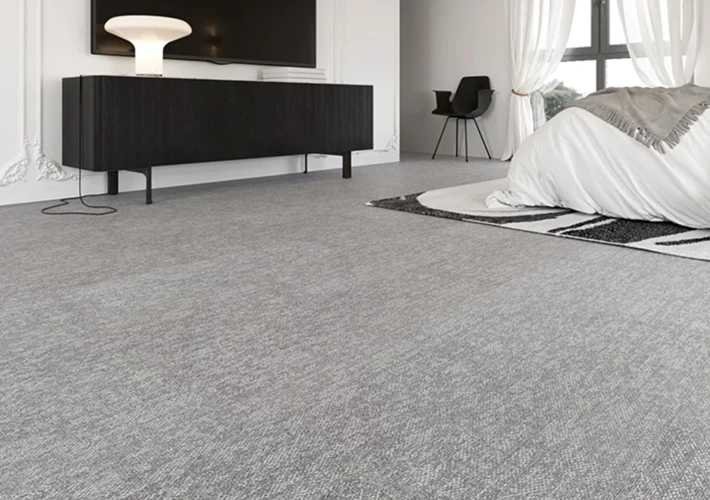
In residential projects, carpet look SPC flooring offers an alternative for homeowners and property developers who like carpet-inspired designs but prefer hard-surface flooring.
Suitable areas may include:
- Bedrooms.
- Living rooms.
- Home offices.
- Study rooms.
- Rental apartments.
- Residential corridors.
Its waterproof core can provide additional reassurance in homes where accidental spills and routine cleaning are common.
For rental property developers, maintenance simplicity and replacement convenience can also be important considerations.
3.5 Educational and Administrative Buildings
Schools, training centers, libraries, and administrative facilities often need flooring that balances durability, appearance, and maintenance requirements.
Carpet-inspired SPC designs can be used in selected indoor spaces such as:
- Staff offices.
- Administrative rooms.
- Meeting rooms.
- Library reading areas.
- Training rooms.
- Student activity spaces.
For these applications, buyers should pay particular attention to indoor air quality, fire performance, slip resistance, and the durability of the installed floor system.
A waterproof core alone does not establish that a product is suitable for every institutional environment. Product-specific test reports and local compliance requirements remain essential.
3.6 Healthcare and Commercial Service Facilities
Selected healthcare administration areas, clinics, consultation offices, and commercial service facilities may also consider carpet look SPC flooring.
The easy-clean surface can be useful in environments where routine cleaning is important.
However, healthcare projects often have more demanding requirements for hygiene, chemical resistance, fire safety, rolling loads, and seamless or hygienic flooring systems.
Therefore, carpet look SPC should only be specified where its joints, surface properties, cleaning compatibility, and applicable certifications meet the project’s requirements.
For critical treatment areas or spaces requiring specialized hygienic flooring, other flooring systems may be more appropriate.
Important Buying Considerations When Purchasing Carpet Look SPC Flooring
For flooring importers, wholesalers, distributors, and construction contractors, purchasing SPC flooring requires more than comparing quotations.
Different manufacturers may offer products with similar appearances but significant differences in core formulation, wear layer thickness, locking system, and quality consistency.
The following factors should be evaluated before placing a bulk order.
4.1 Check the Total Thickness and Core Thickness
Total thickness is one of the first specifications buyers usually compare.
Common SPC flooring thickness options include:
- 4.0 mm.
- 4.5 mm.
- 5.0 mm.
- 5.5 mm.
- 6.0 mm.
- 7.0 mm and above for selected product ranges.
However, total thickness should not be considered independently.
For example, a flooring product with a total thickness of 5 mm may include a 4 mm SPC core and a 1 mm IXPE underlay. Another product with the same total thickness may have a thicker core but no attached backing.
These products can have different structural and acoustic characteristics.
Before purchasing, request a complete layer-by-layer construction specification.
| Specification | What Buyers Should Check |
|---|---|
| Total thickness | Overall product thickness |
| SPC core thickness | Thickness of the rigid core |
| Wear layer | 0.3 mm, 0.5 mm, or other options |
| Decorative film | Pattern clarity and consistency |
| UV coating | Surface protection and finish |
| Underlay | IXPE, EVA, or no attached backing |
| Edge profile | Standard edge or micro-beveled edge |
A reliable manufacturer should be able to explain the complete product construction rather than providing only the total thickness.
4.2 Select the Appropriate Wear Layer
The wear layer directly affects the surface protection of SPC flooring.
For buyers targeting different market segments, selecting the correct wear layer can help balance product price and application requirements.
A practical purchasing reference is:
| Wear Layer | Potential Market Positioning |
|---|---|
| 0.2 mm | Entry-level residential flooring |
| 0.3 mm | Residential and selected light commercial applications |
| 0.5 mm | Medium-to-heavy commercial applications, depending on testing |
| 0.7 mm | Selected demanding commercial applications |
These options should be evaluated alongside abrasion resistance, scratch resistance, and the manufacturer’s technical documentation.
For example, a flooring distributor targeting office renovation contractors may prefer a 0.5 mm wear layer because it provides a more suitable starting specification for many commercial projects.
However, a thicker wear layer does not automatically guarantee better overall flooring quality. The complete flooring structure and test performance must also be considered.
4.3 Evaluate the SPC Core Density and Formulation
The core layer determines much of the product’s structural performance.
Buyers should pay attention to the consistency of the SPC formulation, including:
- PVC resin quality.
- Calcium carbonate quality and particle characteristics.
- Stabilizer formulation.
- Processing additives.
- Core density.
- Extrusion and cooling conditions.
Excessive or poorly controlled filler content can negatively affect certain mechanical properties, while inconsistent manufacturing conditions may lead to dimensional or locking problems.
It is therefore important to evaluate more than the advertised density figure.
Ask the supplier for relevant test results and inspect samples for flatness, edge quality, rigidity, and dimensional consistency.
4.4 Inspect the Decorative Pattern and Surface Texture
The visual quality of carpet look SPC flooring is especially important because its main selling point is the carpet-inspired appearance.
Buyers should examine:
Pattern clarity: The decorative pattern should be sharp and visually consistent without obvious printing defects.
Color consistency: Samples from different production batches should maintain an acceptable color appearance.
Pattern repetition: Repeated decorative patterns should be reviewed to avoid an artificial appearance across large floor areas.
Surface embossing: If the product uses embossed surface textures, check whether the texture complements the printed design.
Gloss level: Matte and low-gloss surfaces are often preferred for carpet-inspired designs because they create a more natural textile-like visual effect.
For large hospitality and commercial projects, request multiple samples from the same production batch to assess the overall visual consistency.
4.5 Examine the Click-Locking System
The locking system is another important factor in SPC flooring procurement.
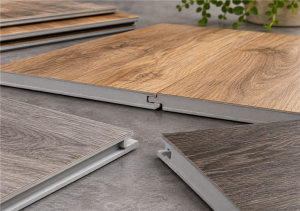
Many SPC flooring products use a click-lock installation system that connects individual planks or tiles without requiring full-surface adhesive application.
A reliable locking system should provide:
- Accurate profile dimensions.
- Consistent connection between panels.
- Secure joint engagement.
- Minimal visible gaps.
- Appropriate resistance to joint damage during installation and use.
For carpet look SPC flooring, the locking system should be evaluated using actual samples rather than relying only on supplier descriptions.
Buyers should assemble several pieces, inspect the connections, and check whether the surface remains flat after installation.
If the product is designed for glue-down installation, confirm the adhesive requirements and installation method separately.
4.6 Confirm Dimensional Stability
Temperature changes can affect resilient flooring products.
Inadequate dimensional stability may lead to expansion, contraction, edge lifting, joint opening, or other installation problems.
For international buyers, this is particularly relevant because products may be shipped across different climates and installed in environments with varying indoor temperatures.
Ask manufacturers about relevant testing methods, including ISO 23999 for dimensional stability and curling behavior.
Other useful standards include ISO 24346 for thickness measurement and ISO 24342 for length, width, and squareness.
For projects requiring ASTM compliance, ASTM F3261 is particularly relevant to modular resilient flooring with a rigid polymeric core. It covers product requirements and performance characteristics for this flooring category. ASTM Store+1
4.7 Request Product Samples Before Bulk Purchasing
A product sample is one of the most effective ways to evaluate a new SPC flooring supplier.
Before confirming a container order, buyers should request samples to assess:
- Decorative appearance.
- Color accuracy.
- Surface texture.
- Overall thickness.
- Wear layer construction.
- Core rigidity.
- Locking performance.
- Edge finishing.
- Underlay quality, if included.
For distributors developing a new product collection, it is also advisable to compare several designs under the same lighting conditions.
This helps reduce the risk of selecting a design that looks attractive in a digital catalog but performs poorly in actual showroom displays.
4.8 Compare Suppliers Based on More Than Unit Price
A low quotation does not always represent the lowest total purchasing cost.
Buyers should consider the following factors:
| Purchasing Factor | Why It Matters |
|---|---|
| Factory production capacity | Helps support repeat orders |
| Raw material control | Influences product consistency |
| Quality inspection | Reduces defects and complaints |
| Customization options | Supports local market preferences |
| Packaging quality | Reduces transportation damage |
| Production lead time | Supports project scheduling |
| Export experience | Helps simplify international orders |
| After-sales support | Helps resolve product issues |
For long-term B2B cooperation, choosing a manufacturer with stable production management and clear communication is often more valuable than obtaining the lowest initial quotation.
Technical Specifications and Quality Control: What Should Buyers Request?
Technical documentation is essential when importing waterproof carpet look SPC flooring.
A professional supplier should provide clear specifications that allow buyers to compare different products and assess their suitability for residential or commercial projects.
5.1 Typical SPC Flooring Technical Specification Reference
The following table provides an illustrative specification framework for carpet look SPC flooring. Actual values should be confirmed with the manufacturer for each product model.
| Technical Item | Common Options or Considerations |
|---|---|
| Product type | Carpet look SPC rigid core flooring |
| Total thickness | 4.0–6.0 mm |
| Wear layer | 0.3–0.5 mm |
| SPC core | Rigid mineral-filled PVC composite |
| Decorative design | Woven, geometric, textile-inspired |
| Surface finish | Matte, low-gloss, UV coating |
| Installation | Click-lock or glue-down, depending on model |
| Underlay | IXPE or EVA optional |
| Plank/tile format | Customizable according to product design |
| Edge treatment | Square edge or micro bevel |
| Application | Residential and selected commercial interiors |
| Maintenance | Sweeping and damp mopping |
These are reference options, not guaranteed specifications for every Changflor product. Buyers should request a model-specific technical data sheet before ordering.
5.2 Important Quality Tests for SPC Flooring
Quality testing helps determine whether a flooring product can meet the requirements of its intended market.
The following tests are particularly relevant.
Wear Layer Thickness Test
Checks whether the transparent protective layer meets the declared specification.
Dimensional Stability Test
Evaluates changes in flooring dimensions after exposure to specified temperature conditions.
Residual Indentation Test
Measures how the flooring responds to static loading and whether permanent deformation occurs.
Abrasion Resistance Test
Evaluates the product’s resistance to surface wear under defined testing conditions.
Chemical Resistance Test
Checks the surface response to selected household or commercial chemicals.
Impact Resistance Test
Evaluates resistance to damage caused by impact under specified conditions.
Slip Resistance Test
Assesses surface friction under defined testing conditions. Requirements vary depending on the target market and application.
Indoor Air Quality Testing
Evaluates VOC emissions and other relevant indoor air quality characteristics.
ASTM and ISO standards provide useful testing frameworks, but buyers should confirm that the specific test method applies to their product and market. Intertek’s resilient flooring testing guidance also identifies abrasion, chemical resistance, impact resistance, dimensional stability, and heat stability as important evaluation areas. Intertek+1
5.3 Factory Quality Control Before Shipment
For overseas importers, factory quality control is particularly important because inspecting every carton after international delivery can be expensive.
A professional SPC flooring manufacturer should establish quality inspection procedures throughout production.
A typical quality control process includes:
Raw Material Inspection
Check incoming PVC resin, calcium carbonate, additives, decorative films, and wear layer materials.
Production Process Inspection
Monitor extrusion conditions, core thickness, product flatness, and production consistency.
Surface Inspection
Inspect decorative printing, color differences, coating quality, and visible surface defects.
Dimensional Inspection
Measure product length, width, thickness, squareness, and locking profile dimensions.
Locking System Inspection
Assemble sample pieces and inspect joint fit and connection strength.
Finished Product Inspection
Check appearance, packaging, product labels, carton quantities, and batch identification.
Pre-Shipment Inspection
Confirm order quantities, product specifications, packaging condition, and loading arrangements.
For container orders, buyers can also arrange third-party inspections based on an agreed sampling and acceptance procedure.
Carpet Look SPC Flooring vs. Other Flooring Options
When choosing a flooring product for a commercial or residential project, buyers often compare SPC flooring with traditional carpet, carpet tiles, LVT, and other rigid-core flooring products.
Understanding the differences helps distributors position their product collections more effectively.
6.1 Carpet Look SPC Flooring vs. Traditional Carpet Tiles
Traditional carpet tiles are manufactured using textile fibers attached to a backing layer.
They offer genuine textile texture and can provide a soft walking experience.
However, they may require more specialized maintenance and can retain dirt or moisture within the fiber structure.
Carpet look SPC flooring provides a different solution.
| Comparison | Carpet Look SPC | Traditional Carpet Tiles |
|---|---|---|
| Construction | Rigid SPC core | Textile fibers and backing |
| Appearance | Printed carpet design | Real carpet surface |
| Water absorption | Low core water absorption | Depends on fibers and backing |
| Cleaning | Damp cleaning where permitted | Vacuuming and specialized cleaning |
| Softness | Hard-surface flooring feel | Soft textile feel |
| Replacement | Depends on installation system | Individual tiles can often be replaced |
| Maintenance | Generally simpler | Often more intensive |
For buyers, the right choice depends on whether the project prioritizes authentic textile comfort or hard-surface practicality.
6.2 Carpet Look SPC Flooring vs. Wood Look SPC Flooring
Both products use a similar rigid-core flooring structure, but their decorative applications are different.
Wood look SPC flooring reproduces natural wood grain, oak, walnut, and other timber appearances.
Carpet look SPC flooring focuses on textile-inspired patterns and colors.
Wood-look designs are commonly selected for residential living spaces, apartments, hotels, and retail interiors.
Carpet-inspired designs are useful when designers want to create the visual impression of carpet in offices, meeting rooms, hospitality spaces, and selected residential interiors.
For wholesalers, offering both categories can help build a more complete SPC flooring collection.
6.3 Carpet Look SPC Flooring vs. LVT Flooring
SPC and LVT are both resilient vinyl flooring categories, but their core construction is different.
SPC uses a rigid mineral-filled core, while traditional flexible LVT uses a more flexible vinyl-based structure.
| Comparison | SPC Flooring | Traditional Flexible LVT |
|---|---|---|
| Core | Rigid mineral composite | Flexible vinyl structure |
| Stability | Rigid construction | More flexible |
| Installation | Commonly click-lock | Glue-down or click, depending on product |
| Subfloor requirements | Requires a suitable, level substrate | Requires careful substrate preparation |
| Underfoot feel | Firmer | Often more flexible |
| Design | Wood, stone, carpet-inspired | Wood, stone, carpet-inspired |
Neither option is universally better.
SPC may be suitable for projects that prioritize a rigid click-lock system, while glue-down LVT may be more appropriate for certain commercial environments requiring a different installation approach.
Buyers should evaluate the project specifications before deciding.
6.4 Why Should Distributors Add Carpet Look SPC to Their Product Collections?
For flooring wholesalers and distributors, product differentiation is important.
A collection consisting only of wood-look and stone-look SPC flooring may not fully address the requirements of every interior design project.
Adding carpet-inspired designs can provide several commercial advantages:
- More decorative options for architects and designers.
- Additional product choices for commercial renovation contractors.
- Opportunities to serve hospitality projects.
- Greater flexibility in showroom displays.
- Potential cross-selling opportunities with existing SPC flooring collections.
It also allows distributors to offer different decorative categories using similar rigid-core flooring technology.
How to Choose a Reliable Carpet Look SPC Flooring Manufacturer in China
Selecting the right factory is an important step for importers and distributors planning long-term cooperation.
China has an established manufacturing supply chain for SPC flooring, including raw material processing, decorative film production, flooring extrusion, surface treatment, packaging, and international logistics.
However, factory capabilities vary considerably.
Buyers should evaluate manufacturers based on production management, technical capabilities, customization services, and export experience.
7.1 Verify Manufacturing Capabilities
A reliable Chinese flooring manufacturer should be able to explain its production process and demonstrate how it controls product quality.
Important questions include:
- Does the factory manufacture SPC flooring directly?
- What total thicknesses and wear layer options are available?
- Can the factory produce customized carpet-inspired patterns?
- What locking systems are available?
- Can the supplier provide model-specific technical data sheets?
- Does the factory conduct routine dimensional and appearance inspections?
- Can it support repeat orders with consistent specifications?
For B2B customers, direct factory cooperation can help improve communication and reduce unnecessary intermediaries.
7.2 Check Customization and OEM/ODM Services
Different markets have different flooring preferences.
For example, some European buyers may prefer neutral grey and beige designs, while buyers in North America may request darker patterns or larger plank formats.
A manufacturer offering OEM/ODM services can help distributors develop products that match their target market.
Common customization requirements include:
Color Customization: Develop specific color combinations based on approved samples.
Pattern Customization: Select or develop carpet-inspired decorative designs.
Product Dimensions: Choose suitable plank or tile sizes according to the production range.
Wear Layer Options: Select protective layer thickness according to the intended application.
Underlay Options: Choose IXPE, EVA, or alternative backing configurations where available.
Packaging Customization: Add private labels, product information, carton designs, and branding.
Before mass production, buyers should approve the final sample and confirm the product specification in writing.
7.3 Evaluate Production Capacity and Delivery Reliability
For distributors and importers, stable delivery schedules are essential.
A delayed flooring shipment may affect showroom replenishment, project installation schedules, and customer commitments.
When evaluating a supplier, ask about:
- Monthly production capacity.
- Current production workload.
- Sample preparation time.
- Standard production lead time.
- Custom order lead time.
- Raw material availability.
- Container loading capacity.
- Export packaging arrangements.
Production lead times should be confirmed according to the order quantity, customization requirements, and factory schedule rather than relying on a general estimate.
7.4 Review Export Experience and Packaging Standards
International transportation creates additional risks for flooring products.
SPC flooring cartons must be packed properly to reduce damage during handling and shipping.
Buyers should review:
- Carton strength and dimensions.
- Internal protective packaging.
- Product labeling.
- Pallet requirements.
- Moisture protection.
- Container loading arrangements.
- Shipping marks and documentation.
For large projects, packaging specifications should be agreed upon before production.
A professional supplier should also be able to coordinate export documents and provide the product information required by the importer.
7.5 Why Consider Changflor as Your China SPC Flooring Supplier?
Changflor focuses on SPC and LVT flooring manufacturing and international B2B supply.
For importers, wholesalers, flooring distributors, and project contractors, selecting a factory should be based on product suitability, production consistency, and long-term cooperation potential.
Changflor aims to support international customers with flooring solutions that address different market requirements.
Our B2B cooperation approach focuses on:
- Factory Direct Supply: Work directly with a Chinese flooring manufacturer.
- Product Selection: Explore different SPC and LVT flooring specifications.
- OEM/ODM Support: Discuss customized colors, decorative patterns, dimensions, and packaging.
- Specification Options: Evaluate different total thicknesses, wear layers, and underlay configurations.
- Sample Evaluation: Review product samples before confirming bulk orders.
- Project Support: Discuss flooring specifications according to residential and commercial application requirements.
- Export Cooperation: Coordinate production, packaging, and shipment arrangements for international customers.
Whether you are expanding an existing flooring collection or sourcing materials for a commercial construction project, Changflor can help you evaluate suitable SPC flooring solutions.
Contact our team to discuss your target market, product specifications, and wholesale purchasing requirements.
Frequently Asked Questions About Waterproof Carpet Look SPC Flooring
1. Is Carpet Look SPC Flooring Really Waterproof?
SPC flooring has a rigid mineral-based core that is designed to resist water absorption. This makes it suitable for environments where occasional spills and damp cleaning are expected.
However, waterproof core construction does not mean that the complete installed floor system is automatically waterproof. Installation joints, expansion gaps, and perimeter details must be managed correctly.
2. Does Carpet Look SPC Flooring Feel Like Real Carpet?
No. Carpet look SPC flooring reproduces the visual appearance of carpet through decorative printing and, in some cases, surface embossing.
It retains the hard-surface characteristics of SPC flooring rather than the soft textile feel of traditional carpet.
3. What Wear Layer Is Recommended for Commercial SPC Flooring?
A 0.3 mm wear layer may be suitable for some light commercial applications, while 0.5 mm is often considered for busier commercial environments.
For demanding projects, buyers should also evaluate abrasion resistance, impact performance, maintenance requirements, and relevant test reports.
4. Can Carpet Look SPC Flooring Be Installed in Hotels?
Yes, it can be considered for selected hotel guest rooms, serviced apartments, meeting rooms, and other indoor spaces.
However, buyers should verify fire performance, slip resistance, acoustic requirements, VOC emissions, and commercial durability before specifying it for a hotel project.
5. Is Carpet Look SPC Flooring Suitable for Office Buildings?
Yes. It can be used in selected office spaces, meeting rooms, reception areas, and administrative environments.
For high-traffic offices, buyers should prioritize a suitable wear layer, reliable locking system, dimensional stability, and resistance to rolling furniture loads.
6. Can SPC Flooring Be Customized for Wholesale Orders?
Many Chinese SPC flooring manufacturers offer customization options.
Depending on factory capabilities and minimum order requirements, buyers may be able to customize decorative patterns, colors, dimensions, wear layer thickness, underlay, and packaging.
7. Is SPC Flooring Better Than Traditional Carpet?
Neither product is universally better.
Traditional carpet offers genuine textile softness and a different acoustic experience. SPC flooring offers a hard, moisture-resistant surface that is generally easier to clean.
The appropriate option depends on the project’s design objectives, maintenance budget, performance requirements, and installation conditions.
8. What Documents Should Importers Request from an SPC Flooring Factory?
Importers should request a technical data sheet, product specifications, relevant test reports, and applicable compliance certificates.
Depending on the destination market and project requirements, documentation may cover dimensional stability, wear layer thickness, abrasion resistance, fire performance, slip resistance, and indoor air quality.
9. Can Carpet Look SPC Flooring Be Used with Underfloor Heating?
Some SPC flooring products are compatible with suitable underfloor heating systems.
However, compatibility depends on the flooring construction, heating system, installation method, and manufacturer’s temperature limitations.
Buyers should obtain written confirmation of the product’s suitability before specifying it for heated floors.
10. What Should Buyers Check Before Ordering a Container of SPC Flooring?
Before placing a container order, buyers should confirm:
- Final product design and color.
- Total thickness and wear layer.
- Core construction.
- Locking system.
- Technical performance requirements.
- Approved production sample.
- Carton specifications.
- Order quantity and production schedule.
- Shipping and export documentation.
A clear purchase specification helps reduce misunderstandings and supports more consistent product quality.
Conclusion
Waterproof carpet look SPC flooring combines carpet-inspired decorative aesthetics with the practical characteristics of rigid-core vinyl flooring. Its moisture-resistant core, easy-clean surface, customizable designs, and multiple specification options make it an interesting choice for residential and selected commercial interiors.
For flooring importers and wholesalers, this product category also provides an opportunity to expand beyond conventional wood-look and stone-look SPC collections.
However, successful purchasing depends on selecting the right product construction, wear layer, core formulation, locking system, and manufacturing partner.
Before placing a bulk order, buyers should evaluate physical samples, review technical documentation, and confirm that the selected product meets the requirements of the intended application and destination market.
As a Chinese SPC and LVT flooring supplier, Changflor welcomes cooperation with international flooring distributors, wholesalers, importers, and project contractors.
If you are looking for a reliable China factory for SPC flooring, contact Changflor to discuss wholesale supply, customized designs, OEM/ODM services, and commercial flooring solutions.
Changflor – Professional Flooring Solutions for Global Markets.