
When buyers source SPC flooring, the underlayment is often treated as a small accessory. In reality, the pad or backing can affect joint stability, sound performance, floor feel, moisture management, packaging, and compatibility with the finished click-lock system.
IXPE, EVA, and attached-pad options are not interchangeable specifications. This guide explains how to compare SPC flooring underlayment options, what to confirm on samples, how pad thickness and density influence the finished plank, and which questions to ask an SPC flooring manufacturer before placing a wholesale or private-label order.
What Is SPC Flooring Underlayment?
SPC flooring underlayment is the cushioning or backing layer placed below the rigid stone-polymer composite core. It may be supplied as a separate sheet installed below the flooring or as an attached pad laminated to the bottom of each plank.
An attached pad can simplify product handling and create a more complete plank specification, but it also changes the total thickness, packaging height, joint behavior, and installation requirements. Buyers should record the core, backing, pad material, pad thickness, density, and attachment method in the same technical brief.

Why Underlayment Matters in SPC Flooring
The underlayment works together with the core and click-lock profile. A pad that is too soft, too thick, uneven, or poorly bonded can change how the plank sits on the subfloor and how the joint carries load.
- Joint compatibility: the pad should not create excessive movement or interfere with the locking profile.
- Floor feel: the backing can influence comfort and the perceived firmness underfoot.
- Sound response: pad material and construction may affect impact and reflected sound, but claims should be supported by the relevant test method.
- Moisture planning: a pad is not automatically a moisture barrier; confirm the actual moisture-resistance construction.
- Packaging: attached pads add volume and may change carton quantity, pallet height, and freight calculations.
IXPE Underlayment for SPC Flooring
IXPE is a cross-linked polyethylene foam commonly used as an attached pad or separate underlayment option. It is valued for its closed-cell structure, consistent feel, light weight, and ability to be produced in controlled thicknesses.
When comparing IXPE-backed SPC flooring, buyers should confirm the foam density, thickness, surface condition, bonding method, and whether the pad is intended for the specific locking profile. The same material name can cover different constructions, so the technical sheet should not stop at “IXPE.”
Inspect the pad for even thickness, clean edges, smooth bonding, and consistent attachment across the plank. Ask whether the pad is laminated during production or applied in a later process.
EVA Underlayment for SPC Flooring
EVA foam is another common option. Its formulation and density can produce a different balance of resilience, softness, and compression response from IXPE. Buyers should compare the complete construction rather than assuming that one material is universally better.
For EVA-backed products, ask for the density, thickness, compression behavior, temperature range, and bonding details. A pad that feels soft in a sample room may compress differently under furniture loads or after transport and storage.
Sample approval should include the actual EVA construction that will be used in mass production. A supplier should not substitute a different pad grade without updating the buyer.
Attached Pad Versus Separate Underlayment
Attached pad
An attached pad is laminated or bonded to the bottom of the SPC flooring plank. It can make the product easier to handle and can help maintain a defined product construction when the pad is properly controlled.
However, the attached pad becomes part of the total plank specification. Buyers must check the final thickness, joint height, door-clearance assumptions, carton dimensions, and whether an additional underlayment is prohibited or unnecessary.
Separate underlayment
A separate underlayment offers more flexibility because the installer or distributor can select a pad for a particular subfloor condition. It also creates a greater risk of the wrong combination being used.
Ask the supplier whether the SPC flooring is approved for a separate pad and what limits apply to thickness, compressibility, and moisture performance. Do not assume that a separate underlayment can be added beneath every click-lock product.
How Pad Thickness and Density Affect the Finished Product
Thickness and density should be reviewed together. A thicker pad is not automatically a higher-quality pad, and a softer pad may not provide the best support for a rigid click-lock floor.
Excessive compressibility can allow more vertical movement at the joints. An uneven or weakly bonded pad can create a different feel from one plank to the next. The correct specification depends on the core, profile, subfloor requirements, product warranty, and intended installation method.
Ask the manufacturer to state pad thickness and density as separate values. If the quotation only says “with foam backing,” it is not specific enough for a repeatable purchase.
Underlayment and Click-Lock Compatibility
The click-lock system is designed to work with a defined plank construction. Adding or changing the underlayment can affect how the joint responds to loading, movement, and repeated assembly.
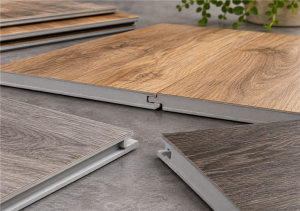
During sample review, assemble several planks on a flat surface with the intended backing. Check seam height, joint closure, edge stability, and whether the plank rocks or flexes excessively. Test both long-side and end-side joints when the profile uses different geometries.
For more information about joint inspection, review our SPC flooring click lock profile guide. The pad, core, and joint should be approved as one construction, not as unrelated components.
Acoustic, Moisture, and Comfort Claims
Underlayment discussions often include sound reduction, moisture resistance, and comfort. These claims must be connected to a test method and a complete system.
- Acoustic claims: ask whether the value refers to impact sound, reflected sound, or another test, and whether the result applies to the full floor assembly.
- Moisture claims: confirm whether the pad is closed-cell, whether seams need a separate barrier, and what subfloor moisture limits apply.
- Comfort claims: compare compression response and floor feel on a controlled sample rather than relying on the material name.
A pad can contribute to performance without being the only factor. The subfloor, room construction, installation method, and complete flooring system also influence the final result.
How to Inspect an Underlayment Sample
Request several full-size planks from the intended product construction. A small foam swatch cannot show whether the pad is attached evenly around the full plank or whether the edge remains compatible with the lock.
- Check the bond: inspect the pad edge for lifting, wrinkles, voids, or areas with weak attachment.
- Review the thickness: compare several points across the plank and note visible variation.
- Feel the density: compare firmness and recovery across several pieces from the same batch.
- Inspect the edges: make sure the pad does not obstruct the click profile or create an uneven perimeter.
- Assemble the planks: test joint closure and surface alignment with the backing attached.
- Check storage behavior: review samples after normal packing and acclimation conditions.
Keep the approved sample, technical data sheet, product code, and packaging reference together. This makes a later repeat-order comparison more reliable.

How Manufacturers Control Attached Underlayment
An SPC flooring manufacturer should explain how the pad is controlled from incoming material through lamination, trimming, inspection, and packing. Useful checkpoints may include:
- Incoming foam material identification and density records.
- Pad thickness and surface condition checks.
- Bonding or lamination temperature and pressure control.
- Edge trimming and alignment with the plank profile.
- Inspection for wrinkles, delamination, contamination, and uneven attachment.
- Joint assembly checks using the finished construction.
- Carton and pallet checks after the attached pad is included.
The approved sample should be connected to a repeatable production record. Ask how the supplier handles a batch that does not meet the approved pad or joint standard.
Packaging and Freight Considerations
Attached underlayment changes the physical volume of SPC flooring. Before ordering, confirm the number of planks per carton, carton dimensions, pallet height, container loading plan, and protection for the pad edges.
Ask whether the pad can be compressed or damaged during stacking. A product that leaves the factory with a clean backing can arrive with crushed edges if the packing method does not protect the underside.
Questions to Ask an SPC Flooring Manufacturer
- Is the underlayment IXPE, EVA, or another material?
- What are the exact pad thickness and density?
- Is the pad attached during production or applied later?
- Is the product approved for an additional separate underlayment?
- How does the pad specification relate to the click-lock profile?
- What acoustic or moisture test method supports each claim?
- How are bonding, thickness, density, and edge alignment inspected?
- What are the MOQ, sample lead time, development cost, and repeat-order controls?
- How will the pad affect carton quantity, pallet height, and freight?
How ChangFlor Can Help
ChangFlor can help buyers compare SPC flooring underlayment options, complete plank construction, click-lock compatibility, packaging, and private-label requirements before a bulk order.
For related information, review our SPC flooring core quality guide, SPC flooring wear layer guide, request a free sample, or send your product brief through the contact page.
Final Checklist
- Identify the exact underlayment material and construction.
- Record pad thickness and density separately.
- Confirm whether the pad is attached or separate.
- Test joint closure with the actual backing.
- Verify acoustic and moisture claims with test methods.
- Inspect bonding, edge alignment, compression, and batch consistency.
- Confirm packaging and freight effects before final quotation.
Conclusion
SPC flooring underlayment is part of the product system, not an afterthought. IXPE, EVA, and attached-pad options can produce different results depending on thickness, density, bonding, core construction, and click-lock design.
By comparing full-size samples and asking an SPC flooring manufacturer for clear material, test, packaging, and quality-control information, buyers can select an underlayment construction that is easier to approve and more consistent to reorder.