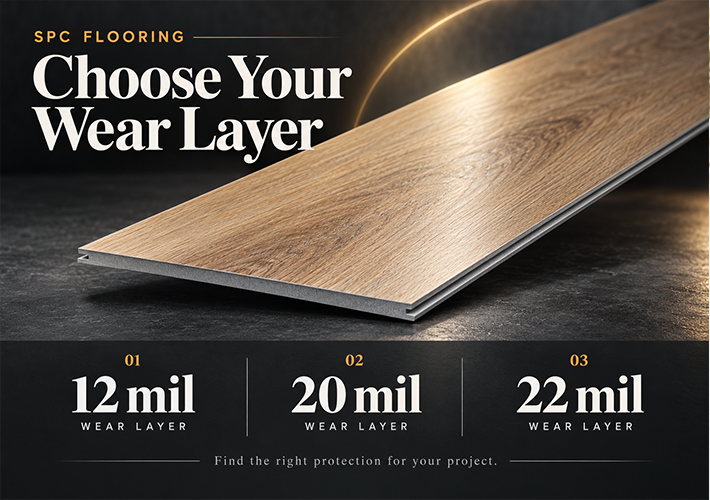
When buyers compare SPC flooring, the wear layer is one of the most important surface specifications to review. It helps define how the finished floor is positioned, but it should never be judged as an isolated number. The right choice depends on the complete SPC flooring construction, surface finish, product design, quality controls, and the commercial requirements behind the order.
This guide explains how to compare 12 mil, 20 mil, and 22 mil wear-layer options, what information an SPC flooring manufacturer should provide, and how importers, distributors, and private-label buyers can make a more reliable product decision before placing a bulk order.
What Is the Wear Layer in SPC Flooring?
The wear layer is the transparent protective layer above the decorative film of an SPC flooring plank. It is designed to protect the visual surface from everyday abrasion and help preserve the appearance of the product during normal use. Beneath it, the decorative film creates the wood or stone visual, while the rigid SPC core provides the main structure of the plank.
In product specifications, the wear layer is commonly described in mil. One mil equals one-thousandth of an inch. Buyers should confirm whether the supplier is quoting the wear layer itself, the complete surface coating, or another measurement. A clear technical data sheet should identify the value and the method used to verify it.
A thicker wear layer can support a higher product position, but thickness alone does not prove that one SPC flooring product will perform better in every situation. Surface texture, coating quality, embossing, print clarity, core formulation, edge profile, installation conditions, and quality control all matter.
12 mil, 20 mil, and 22 mil: What Is the Difference?
For many SPC flooring buyers, 12 mil, 20 mil, and 22 mil represent different product-positioning options. They are useful comparison points when requesting a quotation, but they should be treated as part of a complete specification rather than as universal performance grades.
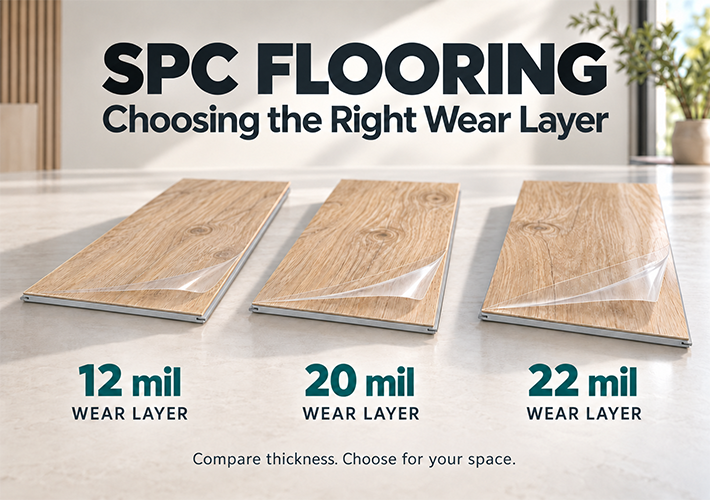
12 mil SPC flooring
A 12 mil wear layer can be suitable for value-oriented product lines and projects where the buyer needs to balance initial cost with a defined surface specification. It may work well as an entry or mid-range option when the rest of the construction, finish, and quality requirements are clearly controlled.
When reviewing a 12 mil product, ask for the complete layer structure, surface finish, backing option, plank dimensions, and approved sample. The buyer should also confirm that the quoted specification remains the same from sample approval through mass production.
20 mil SPC flooring
A 20 mil wear layer is often selected when the product needs a stronger commercial positioning and a more substantial surface specification. It can be a practical middle option for distributors and brands that want a balanced offer across price, appearance, and perceived durability.
Do not compare 20 mil SPC flooring from two suppliers only by the number. Compare the surface coating, texture, gloss, embossing, decorative film, core, backing, edge treatment, and supporting test documents at the same time.
22 mil SPC flooring
A 22 mil wear layer can support a premium product position when the buyer wants additional surface material in the specification. The additional material may affect production cost, carton weight, container planning, and the final wholesale quotation, so the product should be evaluated as a complete construction.
For private-label projects, confirm the approved sample, color reference, surface finish, packaging artwork, and inspection standard before production. A premium specification is valuable only when the supplier can reproduce it consistently from batch to batch.
Wear Layer vs. Total Thickness: Do Not Mix the Numbers
One of the most common mistakes in SPC flooring purchasing is treating the total plank thickness as if it were the wear layer. These are different specifications.
- Total thickness: the combined thickness of the finished plank, which may include the surface, decorative film, SPC core, and attached backing.
- Wear layer: the transparent protective surface layer above the decorative film.
- Backing: an attached layer such as IXPE or EVA when included in the product construction.
- Surface finish: the texture, coating, gloss, embossing, and visual treatment applied to the finished surface.
A 6mm SPC flooring plank does not automatically have a thicker wear layer than a 4mm plank. Likewise, an 8mm product should not be promoted as a better surface product without confirming its actual wear-layer specification and test information. Request these values as separate fields in the quotation sheet.
What Else Affects SPC Flooring Surface Quality?
Wear-layer thickness is important, but buyers should review the following details before choosing an SPC flooring manufacturer.
Surface coating and finish
The coating affects the feel, sheen, cleanability, and visual consistency of the finished surface. Ask whether the finish is matte, semi-matte, or gloss, and whether the quoted finish matches the approved sample.
Embossing and texture
Embossing can influence how natural the wood or stone visual appears. Confirm whether the texture is standard, synchronized with the print, or customized. A supplier should explain how the requested finish is controlled during production.
Decorative film and color consistency
The wear layer protects the visual surface, but the decorative film determines much of the product appearance. Ask about the color reference, repeat pattern, sample approval, and process for controlling shade differences between production batches.
Core and dimensional stability
The rigid core affects the structure and dimensional behavior of the plank. Buyers should review the complete technical data sheet instead of evaluating the surface layer separately from the core, click profile, plank size, and backing.
Edge profile and click-lock machining
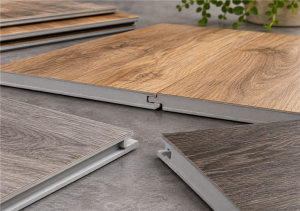
Beveled edges and click-lock profiles can change the appearance, production process, yield, and packaging requirements. If the order is for a private label or a specific product collection, the quotation should identify the exact edge and profile requirements.
How Buyers Should Compare 12 mil, 20 mil, and 22 mil Samples
A sample comparison is more useful when all samples use a similar base specification. Ask the supplier to keep the plank size, decorative design, surface finish, core construction, backing, and edge treatment consistent where possible. Then compare the wear-layer options as a controlled product decision.
- Check that the wear-layer value is written clearly on the sample or technical sheet.
- Compare the surface texture, gloss, print clarity, and edge finish under the same lighting.
- Review the plank construction from the side and confirm whether attached backing is included in total thickness.
- Ask for relevant test reports or quality records that match the quoted construction.
- Keep the approved sample and specification in the purchase file for mass-production reference.
Do not rely on a quick visual inspection to prove the exact wear-layer thickness. The supplier should provide the technical information and explain its internal inspection process. If the order is commercially important, the buyer can also arrange an agreed third-party inspection before shipment.

Questions to Ask an SPC Flooring Manufacturer
Before requesting a final wholesale quote, send the manufacturer a clear product brief. The following questions help prevent different suppliers from quoting different constructions under the same product name.
- Which wear-layer options are available for this SPC flooring design?
- Is the quoted wear layer 12 mil, 20 mil, or 22 mil, and how is it verified?
- Does the total thickness include the attached backing?
- What surface finish, embossing, and gloss level are included?
- Can the supplier keep the decorative film and approved color consistent across repeat orders?
- Which test documents and inspection records can be provided with the quotation?
- What are the sample approval, minimum order, lead time, and packaging conditions?
- Can the supplier provide the same construction in different thicknesses or private-label formats?
How Wear Layer Choice Influences Wholesale Purchasing
A change from 12 mil to 20 mil or 22 mil can affect more than the unit price. It may influence material consumption, production scheduling, carton weight, loading quantity, packaging design, and the product position in the buyer’s catalog.
Ask the supplier to quote each option using the same currency, trade term, quantity, destination, color, plank size, backing, and packaging assumptions. This creates a fair comparison and helps the buyer understand the actual cost of upgrading the surface specification.
For repeat orders, document the approved construction in the purchase contract or order confirmation. A reliable SPC flooring manufacturer should be able to connect the technical specification with sample approval, production control, packing, and pre-shipment communication.
How ChangFlor Can Help Buyers Build the Right SPC Flooring Specification
ChangFlor works with buyers who need to compare SPC flooring constructions before moving to a bulk order. We can discuss wear-layer options, total thickness, surface finish, decorative design, backing, packaging, and private-label requirements based on the buyer’s target market.
Send us your preferred wear layer, plank size, total thickness, quantity, destination, packaging requirements, and target product position. Our team can help organize a sample and quotation request so that the comparison is based on the same technical assumptions.
You can also review our SPC flooring thickness guide and guide to importing SPC and LVT flooring from China before preparing your purchasing brief. For samples, visit the free sample page, or send the complete requirement through our contact page.
Final Checklist for Choosing an SPC Flooring Wear Layer
- Confirm the wear layer separately from total thickness.
- Compare 12 mil, 20 mil, and 22 mil using the same base construction.
- Review surface finish, embossing, decorative film, core, backing, and edge profile.
- Request the technical data sheet and relevant test documents.
- Approve a physical sample before mass production.
- Record the approved color, surface, thickness, and packaging specification.
- Compare quotations using the same quantity, trade term, and destination.
- Verify the manufacturer’s process for repeat-order consistency.
Conclusion
The best SPC flooring wear layer is not simply the thickest option. It is the specification that matches the product position, buyer expectations, commercial terms, and supplier quality controls. By comparing 12 mil, 20 mil, and 22 mil options together with surface finish, core construction, total thickness, packaging, and test information, buyers can make a more reliable purchasing decision.
When you are ready to compare SPC flooring samples or request a manufacturer quotation, send ChangFlor the complete product brief. A clear specification makes the sample review faster, the quote easier to compare, and the final order more consistent.