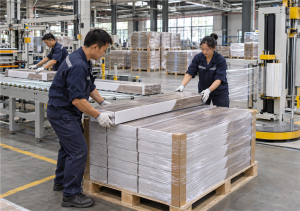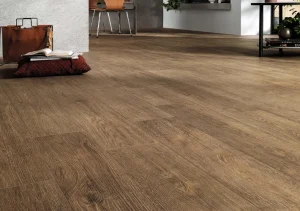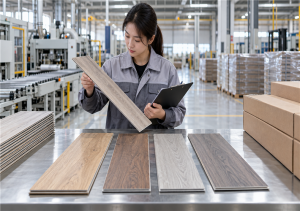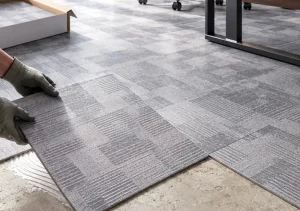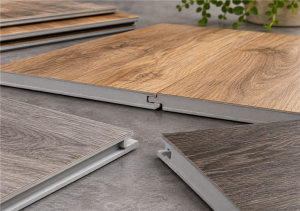
Commercial interior flooring must meet much higher performance requirements than residential flooring. In hotels, shopping malls, office buildings, restaurants, hospitals, educational institutions, and retail stores, floors are exposed to continuous foot traffic, furniture movement, cleaning chemicals, occasional spills, and changing environmental conditions. Choosing the wrong flooring material can lead to premature wear, maintenance problems, safety concerns, and costly renovation projects.
Among the available commercial flooring solutions, SPC waterproof flooring has become an increasingly attractive option for architects, interior designers, contractors, flooring distributors, and commercial project developers. Its rigid stone-plastic composite core, waterproof construction, dimensional stability, and practical installation systems make it suitable for a wide range of commercial environments.
However, waterproof performance is only one reason why SPC flooring is worth considering. Its suitability for commercial interiors also depends on wear-layer thickness, surface treatment, impact resistance, dimensional stability, slip resistance, acoustic performance, installation quality, and long-term maintenance requirements.
For international buyers sourcing flooring products from China, understanding these factors is essential when comparing manufacturers and selecting products for commercial projects.
As a professional China flooring manufacturer, Changflor provides SPC flooring solutions for commercial and residential applications, supporting distributors, wholesalers, importers, contractors, and project buyers with product selection, specifications, and customized supply options.
This article explains what makes SPC waterproof flooring suitable for commercial interiors, how its technical characteristics support different applications, and what B2B buyers should evaluate before placing an order with a Chinese SPC flooring factory.
Understanding SPC Waterproof Flooring and Its Core Structure
SPC stands for Stone Plastic Composite or Stone Polymer Composite. It is a rigid-core vinyl flooring product generally manufactured using a combination of calcium carbonate, PVC resin, stabilizers, and other formulation additives.
Unlike traditional flexible vinyl flooring, SPC flooring features a dense and rigid composite core. This construction provides dimensional stability and resistance to moisture-related damage, making it particularly useful in commercial interiors where environmental conditions and daily usage can vary significantly.
To understand why SPC waterproof flooring performs well in commercial applications, buyers should first examine its multilayer construction.
1.1 The Main Layers of SPC Waterproof Flooring
Although the exact construction varies between manufacturers and product series, a typical SPC flooring plank consists of several functional layers.
1. UV Coating Layer
The UV coating is applied to the surface to improve resistance to everyday wear, stains, and surface deterioration. It also helps protect the decorative finish and makes routine cleaning easier.
For commercial interiors, this layer is important because floors are regularly exposed to shoes, dust, cleaning equipment, and occasional chemical residues.
Different UV coating formulations provide different levels of surface protection. Buyers should therefore evaluate actual product test results rather than assuming that every SPC floor has identical performance.
2. Wear Layer
The transparent wear layer protects the decorative film underneath from abrasion, scratches, and daily friction.
Wear-layer thickness is one of the most important specifications when selecting SPC flooring for commercial projects.
Common specifications include:
- 0.20 mm wear layer: Suitable for selected light-commercial environments with moderate traffic.
- 0.30 mm wear layer: A practical option for many light-commercial applications.
- 0.50 mm wear layer: Often selected for offices, retail spaces, hotels, and other areas with relatively frequent foot traffic.
- 0.70 mm wear layer: A potential choice for demanding commercial applications, subject to the complete flooring construction and test results.
These are general purchasing references, not universal commercial-use classifications. Actual suitability depends on abrasion testing, surface treatment, product construction, and the expected traffic level.
3. Decorative Film Layer
The decorative film determines the visual appearance of SPC flooring.
Modern printing technology allows manufacturers to reproduce different natural materials, including:
- Natural oak and walnut wood grains
- Grey and brown timber patterns
- Marble and stone textures
- Concrete-inspired finishes
- Contemporary geometric patterns
- Carpet-inspired visual designs
This design flexibility is especially valuable in commercial interiors because flooring often forms an important part of a company’s visual identity.
For example, a hotel may prefer natural wood-look SPC flooring to create a welcoming atmosphere, while a modern office may select grey stone-look patterns to achieve a clean and professional appearance.
4. SPC Rigid Core Layer
The SPC core is the structural foundation of the flooring plank. It generally consists of PVC resin, calcium carbonate, and formulation additives processed under controlled manufacturing conditions.
Its main functions include:
- Providing rigidity and structural support
- Improving dimensional stability
- Reducing sensitivity to moisture
- Supporting the locking installation system
- Helping the flooring maintain its shape during normal use
The quality of the SPC core depends on raw material selection, formulation ratios, mixing processes, extrusion conditions, and manufacturing quality control.
A high-quality rigid core should provide consistent thickness, appropriate density, stable dimensions, and reliable locking performance.
5. Attached Underlayment (Optional)
Some SPC flooring products include an attached underlayment, commonly made from IXPE or EVA foam.
This layer can help improve walking comfort, reduce certain types of impact sound, and provide a more comfortable flooring experience.
However, attached underlayment is not automatically suitable for every commercial project. Buyers should confirm compatibility with the installation system, substrate requirements, acoustic targets, and manufacturer instructions.
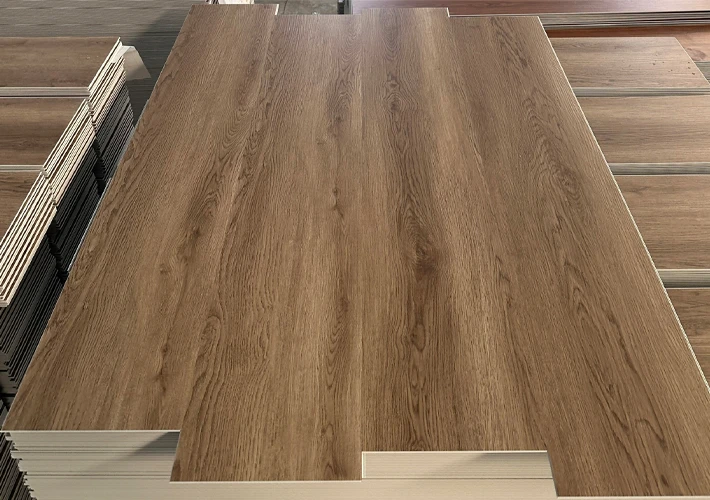
1.2 Why the Rigid Core Structure Matters in Commercial Environments
Commercial flooring must withstand more demanding conditions than flooring used in many private homes.
A retail store may receive hundreds of visitors every day. A hotel corridor experiences continuous movement of guests, staff, luggage carts, and housekeeping equipment. An office floor must accommodate rolling chairs, desks, filing cabinets, and frequent cleaning.
The rigid SPC core provides a stable foundation for these applications.
Compared with traditional flexible vinyl flooring, SPC products generally offer greater rigidity and better resistance to certain types of indentation under appropriate installation and loading conditions.
Nevertheless, rigidity should not be confused with unlimited impact resistance. Heavy concentrated loads, sharp objects, improper furniture installation, and uneven subfloors can still damage SPC flooring.
For project buyers, the important consideration is not simply whether a product has an SPC core, but whether the complete flooring system has been designed and tested for the intended commercial environment.
1.3 SPC Flooring Compared with Other Commercial Flooring Materials
Commercial buyers often compare SPC flooring with LVT, laminate flooring, ceramic tiles, and traditional vinyl flooring.
| Flooring material | Main characteristics | Potential applications |
|---|---|---|
| SPC flooring | Rigid core, waterproof construction, wood and stone designs | Offices, retail, hotels, commercial interiors |
| Dry-back LVT | Flexible vinyl construction, adhesive installation | Retail, offices, commercial renovation |
| Laminate flooring | Decorative surface, fiberboard-based core | Selected dry commercial interiors |
| Ceramic tiles | Hard surface, water resistance, high durability | Bathrooms, kitchens, public spaces |
| Carpet tiles | Soft underfoot, acoustic comfort | Offices, meeting rooms, hotels |
SPC flooring offers a balance between decorative flexibility, moisture resistance, practical installation, and maintenance convenience.
It is not necessarily the best choice for every project. For example, areas exposed to industrial chemicals, extreme temperatures, heavy point loads, or specialized fire-performance requirements may require alternative flooring systems.
The correct material should always be selected according to the actual operating environment.
Excellent Waterproof Performance for Moisture-Prone Commercial Areas
One of the biggest advantages of SPC waterproof flooring is its resistance to water and moisture. In commercial environments, floors are frequently exposed to liquid spills, wet shoes, cleaning water, and changes in indoor humidity.
Traditional wood-based flooring materials can absorb moisture, causing swelling, deformation, or deterioration over time. SPC flooring offers a different solution because its rigid polymeric core does not behave like conventional wood-based core materials.
2.1 Why SPC Flooring Is Waterproof
The waterproof characteristics of SPC flooring mainly come from its material composition and construction.
The core layer combines PVC resin with calcium carbonate and other additives. Unlike traditional laminate flooring, which commonly uses a wood-fiber-based core, SPC flooring does not rely on a moisture-sensitive wood substrate.
This gives SPC several practical advantages:
- Low water absorption: The rigid polymeric core resists water penetration and does not readily absorb moisture like conventional wood-based cores.
- Reduced swelling risk: The core is less susceptible to moisture-related swelling and expansion.
- Easy spill management: Common liquid spills can generally be removed with routine cleaning.
- Suitable for humid interiors: Properly selected SPC flooring can be used in many indoor environments where humidity and occasional water exposure are concerns.
- Simplified maintenance: Its surface can be cleaned without the specialized treatments required by some natural flooring materials.
It is important to distinguish between a waterproof SPC plank and a completely waterproof installed floor system. Water may still enter through joints, perimeter gaps, doorways, or poorly sealed transitions. Moisture can also affect the subfloor beneath the flooring.
Therefore, proper installation, substrate preparation, expansion allowances, and moisture management remain essential.
2.2 Commercial Environments Where Waterproof SPC Flooring Is Useful
Hotels and Hospitality Facilities
Hotel flooring is exposed to luggage, beverage spills, cleaning operations, and frequent guest movement. Guest rooms, corridors, reception areas, and selected back-of-house spaces may benefit from SPC flooring.
For hotel projects, wood-look SPC flooring can create a warm and welcoming appearance while offering easier routine maintenance than many natural wood flooring options.
Restaurants and Cafés
Restaurants and cafés regularly experience food spills, beverage splashes, and frequent cleaning.
SPC flooring can be considered for suitable dining areas, cafés, and selected customer-facing spaces. Buyers should select products with appropriate slip-resistance characteristics and verify compatibility with the cleaning procedures used by the facility.
However, commercial kitchens and food-preparation areas may require specialized flooring systems with specific drainage, chemical-resistance, and slip-resistance properties. Standard floating SPC flooring should not automatically be specified for these environments.
Shopping Malls and Retail Stores
Retail flooring must maintain an attractive appearance while accommodating continuous pedestrian traffic.
Customers may enter with wet shoes during rainy weather, while cleaning staff regularly mop the floor. SPC flooring offers a practical combination of water resistance, decorative flexibility, and relatively straightforward cleaning.
Office Buildings
Office environments often experience occasional coffee spills, water leaks, and routine cleaning.
SPC flooring can provide a professional appearance while helping facility managers reduce the maintenance burden associated with moisture-sensitive flooring.
Educational and Healthcare Facilities
Schools, training centers, clinics, and selected healthcare interiors require flooring that is easy to clean and suitable for frequent use.
SPC flooring may be considered for approved applications, provided the selected product meets the project’s indoor air quality, fire, slip-resistance, hygiene, and regulatory requirements.
For healthcare facilities, the project specification should also consider welded or sealed flooring systems where seamless hygiene performance is required.
2.3 Waterproof Flooring Does Not Mean No Installation Requirements
Even when an SPC product has a waterproof core, installation quality directly affects the performance of the finished floor.
Commercial project contractors should pay attention to several details:
- Check the subfloor for moisture, contamination, and unevenness.
- Follow the manufacturer’s requirements for substrate flatness.
- Leave the specified expansion space around walls and fixed objects.
- Use suitable transition profiles at doorways and connections between different flooring materials.
- Follow approved waterproofing details around perimeter areas where necessary.
- Avoid leaving standing water on the installed flooring for extended periods.
- Follow the manufacturer’s instructions for wet-area applications.
For distributors and project contractors, these installation requirements are important because they help prevent problems that might otherwise be incorrectly attributed to product quality.
High Wear Resistance and Durability for Heavy Foot Traffic
Commercial interiors generally experience higher foot traffic than residential environments. A retail store may receive hundreds or thousands of visitors daily, while hotel corridors and office reception areas remain active throughout the working day.
A suitable commercial flooring material must withstand repeated walking, furniture movement, cleaning equipment, and everyday friction without losing its appearance too quickly.
SPC waterproof flooring addresses these requirements through its protective surface construction and rigid core.
3.1 The Wear Layer Determines Surface Protection
The wear layer is a transparent protective layer positioned above the decorative film. It plays an important role in determining how well SPC flooring resists everyday surface abrasion.
For commercial applications, buyers should pay particular attention to wear-layer thickness.
The following table provides a general reference for selecting SPC flooring according to application requirements.
| Wear layer | Typical application considerations |
|---|---|
| 0.20 mm | Selected light-duty commercial environments |
| 0.30 mm | Light-commercial spaces and moderate-use interiors |
| 0.50 mm | Many offices, hotels, retail spaces, and commercial projects |
| 0.70 mm | More demanding commercial environments requiring additional surface protection |
These recommendations are indicative rather than universal. A thicker wear layer does not automatically guarantee better overall flooring performance. Surface coating quality, abrasion resistance, maintenance conditions, and complete product testing must also be considered.
For example, an SPC floor with a 0.50 mm wear layer and an effective UV protective coating may be a suitable option for a hotel reception area, depending on the expected traffic and maintenance requirements.
3.2 Resistance to Scratches and Everyday Surface Damage
Commercial flooring encounters many sources of surface abrasion:
- Shoes carrying dust, sand, and small particles
- Office chairs moving repeatedly across the floor
- Furniture being repositioned
- Shopping carts and luggage
- Cleaning machines and maintenance equipment
- Small objects accidentally dropped onto the surface
SPC flooring can be manufactured with different surface finishes to improve resistance to scratches, stains, and everyday wear.
For example, UV coatings and specialized protective treatments can help maintain the decorative appearance.
However, SPC flooring should not be described as completely scratch-proof. Sharp metal objects, heavy dragging, abrasive dirt, and unsuitable cleaning tools can still damage the surface.
Commercial buyers should consider the actual usage conditions and request relevant abrasion and surface-resistance test reports.
3.3 Resistance to Indentation and Furniture Loads
In commercial interiors, flooring must support furniture, equipment, and concentrated loads.
Office environments provide a typical example. Desks, filing cabinets, meeting tables, and chairs create repeated pressure on the floor surface.
The rigid SPC core provides structural support, while the complete flooring construction determines how the product responds to different loads.
Buyers should distinguish between:
- Residual indentation: How much permanent deformation remains after a specified load is removed.
- Static load resistance: How the flooring responds to a specified static load under defined test conditions.
- Rolling-load resistance: How the flooring performs under repeated movement of wheeled loads.
- Impact resistance: How the flooring responds to sudden impacts from dropped objects.
These properties should be evaluated separately because one test cannot establish all aspects of flooring durability.
For projects with heavy display cabinets, commercial shelving, rolling equipment, or concentrated furniture loads, the flooring specification should be checked carefully.
3.4 Why Surface Texture Also Matters
SPC flooring is available with different surface textures, including:
- Embossed wood grain
- Embossed-in-register (EIR) textures
- Lightly brushed finishes
- Stone textures
- Matte surfaces
- Smooth contemporary finishes
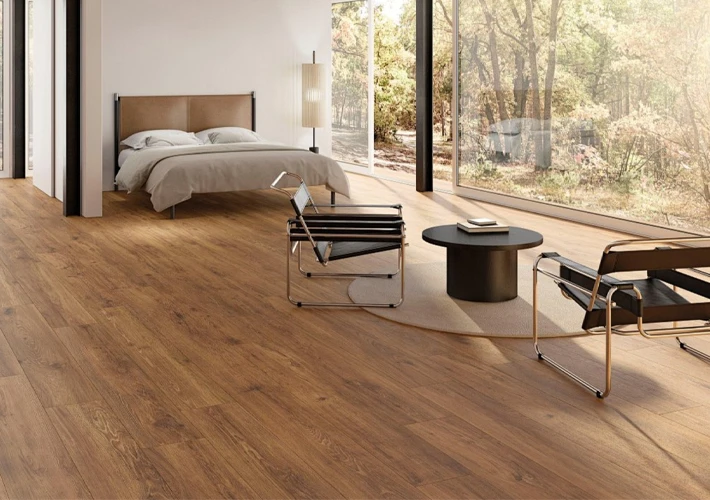
An EIR surface aligns the embossed texture with the printed decorative pattern, creating a more realistic natural wood appearance.
This is especially useful for hotels, offices, and retail stores that want to combine practical flooring performance with an attractive interior design.
A realistic oak or walnut texture can help create a premium atmosphere without requiring natural hardwood flooring.
3.5 Choosing the Right Flooring for Different Traffic Levels
A successful commercial flooring specification should start with an assessment of expected foot traffic.
For example:
- Small offices may require light-commercial flooring with moderate wear resistance.
- Hotel guest rooms may prioritize appearance, comfort, and ease of cleaning.
- Hotel corridors may require higher wear resistance because of continuous pedestrian and luggage movement.
- Retail stores may need more durable surface protection because of frequent customer traffic.
- Large shopping centers may require products with verified commercial-use classifications and appropriate maintenance warranties.
For international B2B buyers, requesting a technical data sheet with test methods and actual results is more reliable than choosing a product based solely on its advertised thickness.
Dimensional Stability and Reliable Performance in Different Commercial Environments
Commercial buildings are not always maintained at the same temperature and humidity throughout the year.
Air-conditioning systems, sunlight exposure, seasonal changes, heating equipment, and differences between indoor and outdoor temperatures can influence flooring performance.
Dimensional stability is therefore another important factor when evaluating SPC waterproof flooring.
4.1 How the SPC Core Supports Dimensional Stability
SPC flooring has a dense rigid core that helps the product maintain its shape under normal indoor conditions.
Compared with conventional wood-based flooring materials, its construction is less sensitive to moisture-related expansion and contraction.
This is useful in commercial buildings where flooring must remain visually consistent across relatively large installation areas.
Dimensional stability can help reduce the risk of:
- Excessive plank expansion
- Contraction-related gaps
- Surface deformation
- Joint separation
- Edge lifting associated with unsuitable installation conditions
Nevertheless, SPC flooring is not completely unaffected by temperature. Excessive heat, direct sunlight, improper storage, and inadequate expansion allowances can still cause dimensional changes or installation problems.
4.2 Why Dimensional Stability Matters in Large Commercial Projects
Consider a commercial office covering 1,000 square meters.
If the selected flooring has inconsistent dimensions or poor dimensional stability, small manufacturing or installation deviations may become more noticeable across the finished area.
Potential consequences include:
- Uneven joints
- Inconsistent plank alignment
- Visible gaps
- Problems around transitions
- Increased installation time
- Additional material waste
For large projects, contractors should prioritize products with consistent thickness, straightness, squareness, and locking-system accuracy.
Manufacturing consistency is especially important for commercial developments where multiple floors or buildings use the same flooring specification.
4.3 Temperature Considerations and Sunlight Exposure
Commercial interiors may include large glass windows, curtain walls, and entrances that receive direct sunlight.
Areas near windows can experience higher surface temperatures than interior spaces.
SPC flooring should therefore be selected according to its stated temperature limits and installation requirements.
Project buyers should check:
- Recommended installation temperature
- Permitted operating temperature
- Dimensional stability test results
- Direct sunlight exposure limitations
- Expansion requirements
- Compatibility with underfloor heating, if applicable
Where large windows create significant solar heat exposure, additional measures such as suitable window shading and appropriate flooring selection may be necessary.
4.4 The Importance of Consistent Manufacturing Quality
Dimensional stability does not depend on the material formula alone.
It is also influenced by manufacturing conditions, including raw material quality, extrusion temperature, production speed, cooling procedures, and dimensional inspection.
For B2B buyers sourcing SPC flooring from China, factory quality control is therefore a major purchasing consideration.
Changflor focuses on supplying SPC and other vinyl flooring solutions for international customers, with product specifications and manufacturing requirements discussed according to the intended application.
For distributors and project contractors, a reliable supplier should be able to provide:
- Product thickness specifications
- Wear-layer measurements
- Plank dimension tolerances
- Core construction details
- Locking-system information
- Dimensional stability test reports
- Batch consistency information
These details help buyers assess whether a product is suitable for repeat orders and long-term commercial supply.
Easy Installation, Maintenance, and Long-Term Operating Efficiency
Commercial flooring projects are often subject to strict construction schedules. Hotels need to complete renovations before reopening, retail stores must minimize downtime, and office buildings may need to renovate individual areas while continuing daily operations.
Installation efficiency and maintenance requirements can therefore have a significant impact on the total cost of a commercial flooring project.
SPC waterproof flooring offers several practical advantages in these areas.
5.1 Click-Lock Installation Reduces Installation Complexity
Many SPC flooring products use a click-lock installation system.
The planks are connected through specially designed locking profiles, allowing installers to join individual pieces without applying adhesive across the entire subfloor in typical floating-floor installations.
The main advantages include:
- Relatively straightforward installation procedures
- Reduced dependence on full-spread flooring adhesives
- Faster installation for suitable projects
- Less adhesive-related odor during installation
- Easier replacement of individual planks in certain floating installations
- Greater flexibility for selected renovation projects
For commercial contractors, these characteristics can help simplify project scheduling and reduce some installation-related costs.
However, installation speed depends on several factors, including the subfloor condition, room layout, plank dimensions, locking-system design, and installer experience.
Some commercial applications may require adhesive installation or partial bonding. Buyers should always follow the specific manufacturer’s installation instructions rather than assuming that every SPC product can be installed as a floating floor.
5.2 Suitable for Selected Commercial Renovation Projects
One reason contractors consider SPC flooring is its potential use in renovation projects.
Traditional flooring replacement may involve removing existing materials, preparing the substrate, transporting construction waste, and completing extensive installation work.
Certain SPC click-lock products can be installed over approved existing hard flooring surfaces when the substrate meets the manufacturer’s requirements.
This can help reduce demolition work in some renovation scenarios.
For example, a hotel may want to update the appearance of its guest rooms without carrying out extensive structural modifications.
Wood-look SPC flooring can provide a refreshed interior appearance while offering a practical installation option.
However, installing over existing flooring is not suitable in every situation. Existing materials must be stable, clean, dry, sufficiently flat, and compatible with the proposed flooring system. Loose tiles, soft flooring, moisture problems, and uneven surfaces must be addressed before installation.
5.3 Low-Maintenance Requirements
Commercial property managers generally prefer flooring that can be maintained through simple, repeatable cleaning procedures.
SPC flooring typically requires routine sweeping or vacuuming to remove dust and loose particles, followed by damp mopping with a suitable neutral cleaning solution.
Compared with some traditional flooring materials, it does not normally require periodic waxing, polishing, or specialized wood treatments.
A basic maintenance routine includes:
- Remove dust, sand, and loose dirt regularly.
- Use a microfiber mop or suitable commercial cleaning equipment.
- Clean spills promptly.
- Use cleaning products approved for the flooring surface.
- Avoid abrasive brushes and unsuitable chemical cleaners.
- Use protective pads under furniture.
- Install entrance mats to reduce the amount of dirt carried indoors.
These measures help preserve the surface appearance and reduce unnecessary wear.
For commercial facilities with regular cleaning schedules, simple maintenance procedures can help reduce labor requirements and support consistent interior presentation.
5.4 Repair and Replacement Flexibility
In commercial environments, localized damage does not always mean that the entire floor needs replacement.
For floating click-lock SPC flooring, individual planks may be replaceable by disassembling the flooring from an appropriate access point or following an approved repair procedure.
This can be particularly useful in:
- Hotel guest rooms
- Office meeting rooms
- Retail display areas
- Commercial corridors
- Reception areas
However, the repair process depends on the installation method and locking-system design.
For B2B buyers, keeping spare planks from the original production batch is a sensible strategy. This helps maintain color and texture consistency when repairs are needed later.
Changflor recommends that project buyers confirm spare-material quantities and production-batch information when planning larger commercial orders.
5.5 Evaluating Total Cost of Ownership
The purchase price per square meter is only one part of a commercial flooring investment.
A more useful evaluation considers the total cost of ownership throughout the expected service period.
| Cost factor | What commercial buyers should evaluate |
|---|---|
| Initial material cost | Price per square meter and product specifications |
| Installation cost | Labor, substrate preparation, and accessories |
| Maintenance cost | Cleaning materials, equipment, and labor |
| Repair cost | Availability of replacement planks |
| Downtime cost | Time required for installation and repairs |
| Replacement cost | Expected service life and replacement requirements |
For example, a slightly more expensive SPC floor with a suitable wear layer and reliable locking performance may provide better long-term value than a cheaper product that does not meet the project’s traffic requirements.
Commercial buyers should therefore compare products based on verified performance and total project requirements rather than focusing exclusively on the factory quotation.
Design Flexibility, Comfort, and Indoor Environmental Considerations
Commercial flooring must perform well, but appearance also plays an important role in interior design.
Hotels, offices, shopping malls, and retail stores often use flooring to create a particular atmosphere, communicate brand identity, and establish visual consistency across different spaces.
SPC waterproof flooring provides a wide range of decorative possibilities.
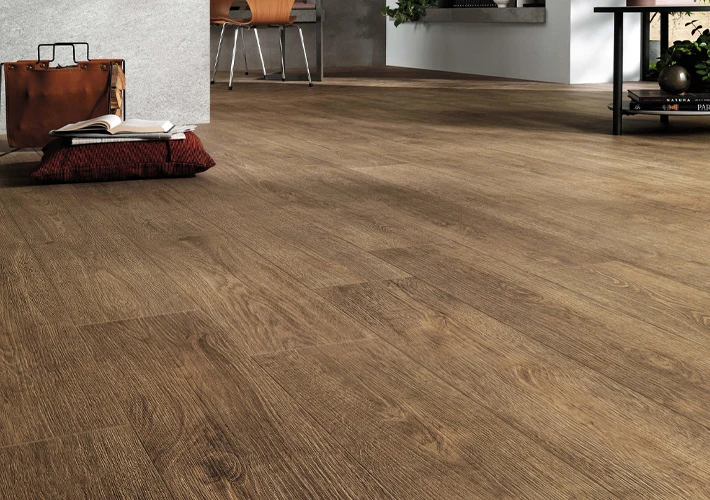
6.1 Wood-Look SPC Flooring for Warm Commercial Interiors
Wood-look SPC flooring is one of the popular choices for commercial interior design.
It reproduces the appearance of natural timber while offering the moisture resistance and maintenance advantages of a rigid-core vinyl product.
Common commercial design options include:
- Natural oak for hotel rooms and reception areas
- Light oak for contemporary offices
- Walnut for premium hospitality interiors
- Grey wood for modern retail environments
- Rustic timber for restaurants and cafés
- Dark wood for luxury commercial spaces
For architects and interior designers, the availability of multiple colors, plank sizes, surface textures, and edge treatments makes it easier to coordinate flooring with furniture, wall panels, doors, and decorative materials.
For projects using multiple flooring finishes, buyers can also discuss customized decorative patterns with their Chinese flooring supplier.
6.2 Stone-Look SPC Flooring for Contemporary Spaces
Stone-look SPC flooring is another practical design option.
It can reproduce the appearance of marble, limestone, concrete, and other natural stone surfaces.
Compared with real stone materials, SPC flooring is generally lighter and can be easier to install in suitable applications.
It also provides a different underfoot experience from hard ceramic or natural stone surfaces.
Common applications include:
- Office reception areas
- Retail stores
- Hotel corridors
- Commercial meeting rooms
- Selected hospitality interiors
- Showrooms and exhibition spaces
The final product should be selected according to the expected traffic, surface performance, and required visual effect.
6.3 Acoustic Comfort in Commercial Interiors
Noise control is an important consideration in modern commercial buildings.
Offices, hotels, educational facilities, and retail spaces can experience noise from footsteps, moving chairs, luggage, and general pedestrian activity.
Some SPC flooring products include an attached IXPE or EVA underlayment.
Depending on the complete flooring construction and installation assembly, this underlayment may help reduce certain types of impact sound and improve walking comfort.
However, acoustic performance varies considerably between products.
A thicker attached pad does not automatically guarantee superior sound insulation. Acoustic results depend on the complete floor assembly, subfloor construction, installation method, and test conditions.
For projects with specific sound-control targets, buyers should request acoustic test reports using the relevant measurement methods.
6.4 Indoor Air Quality and Material Compliance
Indoor environmental quality is increasingly important in commercial construction.
Hotels, schools, healthcare facilities, and office buildings may have specific requirements concerning VOC emissions, chemical composition, and indoor air quality.
SPC flooring buyers should evaluate the following:
VOC Emissions
Volatile organic compounds can be released by various building materials, including flooring, adhesives, coatings, and furniture.
For commercial interiors, low-emission flooring products can support indoor air quality objectives.
Third-party certifications such as FloorScore may be relevant to projects requiring verified flooring emission performance.
Formaldehyde Requirements
Buyers should request appropriate test documentation if formaldehyde emission limits form part of the project specification.
Chemical Composition
Certain markets and projects may restrict specific plasticizers or other substances. Importers should confirm the applicable regulations and obtain relevant product declarations.
Environmental Documentation
Depending on the project, documentation may include environmental product declarations, material disclosures, or other sustainability-related information.
It is important to remember that compliance is product-specific. A factory’s management-system certificate does not automatically prove that every SPC flooring model meets every environmental or indoor-air-quality requirement.
6.5 Fire Performance and Slip Resistance
Fire performance and slip resistance are two critical considerations in commercial flooring selection.
For buildings such as hotels, offices, schools, and shopping centers, flooring may need to comply with regional building regulations and project-specific fire requirements.
Buyers should request fire classification reports based on the applicable standards, such as EN 13501-1 in European projects or ASTM E648 in relevant North American specifications.
Slip resistance should also be evaluated according to the intended application.
A product suitable for a dry office corridor may not be appropriate for a frequently wet entrance or food-service area.
Commercial buyers should therefore check:
- Relevant slip-resistance test methods
- Dry and wet surface performance where applicable
- Surface texture
- Cleaning and maintenance conditions
- Local building code requirements
No single fire or slip-resistance rating should be assumed to apply universally across all markets.
How to Select the Right SPC Waterproof Flooring for Commercial Projects
Selecting SPC flooring for a commercial project requires more than comparing product photographs and factory prices.
Importers, wholesalers, architects, contractors, and purchasing managers should evaluate the product’s complete construction, technical performance, application suitability, and supplier capabilities.
The following considerations can help simplify the purchasing process.
7.1 Match Wear-Layer Thickness to Actual Traffic Requirements
The first step is to understand how the flooring area will be used.
A hotel guest room, office reception, shopping mall corridor, and restaurant dining area have different traffic patterns.
Buyers should consider:
- Expected daily foot traffic
- Furniture movement
- Cleaning frequency
- Potential exposure to sand and dirt
- Rolling loads
- Expected maintenance standards
For many commercial projects, 0.30 mm and 0.50 mm wear-layer options are worth comparing.
Where higher traffic or more demanding operating conditions are expected, a 0.70 mm option may be considered, subject to the product’s complete technical performance.
7.2 Confirm Overall Thickness and Core Construction
SPC flooring is available in different overall thicknesses.
Common commercial product configurations include approximately 4 mm, 5 mm, and 6 mm products, although specifications vary by manufacturer.
Buyers should distinguish between:
- Total product thickness
- SPC core thickness
- Wear-layer thickness
- Decorative film thickness
- Attached underlayment thickness
For example, a product described as 5 mm thick may include an attached underlayment. This does not mean its rigid core alone is 5 mm thick.
Understanding the construction prevents confusion when comparing quotations from different Chinese manufacturers.
7.3 Check the Locking System
The locking system directly affects installation quality and the stability of plank connections.
A commercial SPC flooring product should have accurately manufactured locking profiles that allow planks to connect properly.
Buyers should evaluate:
- Locking-profile design
- Joint tightness
- Connection strength
- Installation method
- Ease of plank replacement
- Consistency across production batches
It is also useful to request physical samples and test the locking connections before approving a large order.
7.4 Request Technical Data Sheets and Relevant Test Reports
A professional SPC flooring supplier should be able to provide technical documentation for the specific product being purchased.
The following standards and testing methods are useful references, depending on the target market and project specification.
| Standard or test | Main purpose |
|---|---|
| ASTM F3261 | Rigid polymeric core resilient flooring specification |
| ISO 23999 | Dimensional stability and curling |
| EN ISO 24340 | Wear-layer thickness measurement |
| EN ISO 24346 | Overall thickness measurement |
| ASTM F1914 | Residual indentation testing |
| ASTM F925 | Chemical resistance |
| ASTM E648 | Critical radiant flux and flooring fire performance |
| EN 13501-1 | Reaction-to-fire classification |
| ISO 10874 | Classification of resilient, textile, and laminate floor coverings by use |
These standards do not all apply to every SPC product or every country. Buyers should identify the standards required by their destination market and confirm that the test reports cover the exact product specification.
The most useful technical documentation should clearly identify the product model, test method, result, laboratory, and applicable report date.
7.5 Evaluate Color Consistency and Surface Quality
For large commercial projects, visual consistency is just as important as technical performance.
Imagine a hotel purchasing 5,000 square meters of SPC flooring. If different production batches show noticeable color variations, the finished rooms and corridors may not have a uniform appearance.
Before confirming an order, buyers should request:
- Physical product samples
- High-resolution surface photographs
- Available color collections
- Surface texture options
- Batch control information
- Production sample approval
For repeat orders, keeping an approved reference sample can help improve consistency.
7.6 Choose a Manufacturer That Understands B2B Requirements
For international importers and project contractors, the supplier’s manufacturing and export capabilities are important purchasing considerations.
A suitable Chinese SPC flooring factory should be able to discuss more than just the unit price.
Important supplier capabilities include:
Product Development
The manufacturer should offer different product structures, colors, textures, plank dimensions, and thickness options according to market demand.
OEM and ODM Support
For flooring distributors and private-label brands, customized packaging, product specifications, and decorative collections can help create a differentiated product range.
Quality Control
Production quality should be managed through raw material inspection, process monitoring, dimensional checks, surface inspection, and finished-product testing.
Export Experience
International buyers may require assistance with packaging specifications, carton labels, pallet arrangements, shipping documents, and container loading.
Stable Supply
For wholesalers and project contractors, reliable production scheduling and consistent product specifications are essential for long-term cooperation.
As a China flooring supplier, Changflor supports B2B customers seeking SPC and LVT flooring solutions for different markets and commercial applications.
7.7 Consider the Requirements of Different Commercial Projects
The following table provides a practical starting point for matching flooring specifications to common commercial environments.
| Commercial application | Key selection priorities |
|---|---|
| Hotel guest rooms | Appearance, moisture resistance, comfort, easy maintenance |
| Hotel corridors | Wear resistance, locking strength, dimensional stability |
| Office buildings | Surface durability, chair compatibility, acoustic considerations |
| Retail stores | Wear-layer performance, stain resistance, attractive designs |
| Shopping centers | Verified commercial classification, durability, maintenance |
| Restaurants | Appropriate slip resistance, cleaning compatibility, spill management |
| Schools | Indoor air quality, durability, fire and slip compliance |
| Clinics | Cleaning requirements, chemical resistance, hygiene specifications |
| Showrooms | Decorative appearance, surface protection, furniture-load considerations |
This comparison should not replace a project-specific technical assessment. Commercial applications often have different regulatory requirements even when they appear similar.
7.8 Why Work with Changflor as Your China SPC Flooring Supplier?
For international flooring distributors and commercial project buyers, sourcing directly from a Chinese manufacturer can offer advantages in product selection, customization, and supply-chain coordination.
Changflor focuses on flooring products for international B2B markets, including SPC and LVT flooring solutions.
When evaluating Changflor for a commercial flooring project, buyers can discuss:
- Different SPC flooring thicknesses and constructions
- Wear-layer options for different traffic requirements
- Wood-look and stone-look decorative collections
- Surface texture and finish options
- Click-lock flooring configurations
- OEM and private-label requirements
- Product samples and technical specifications
- Export packaging and bulk-order arrangements
For importers and wholesalers, these options help build flooring collections suited to different customer segments.
For architects and contractors, discussing the intended application before ordering helps ensure that the selected product matches the project’s technical and visual requirements.
Changflor aims to support customers with practical flooring supply solutions from China, helping commercial buyers coordinate product selection, specifications, and procurement more efficiently.
Frequently Asked Questions About SPC Waterproof Flooring for Commercial Interiors
1. Is SPC waterproof flooring suitable for heavy commercial traffic?
Yes, selected SPC flooring products are suitable for commercial environments with frequent foot traffic.
However, suitability depends on wear-layer thickness, core construction, locking-system strength, surface treatment, and relevant performance test results.
For busy retail stores, hotel corridors, and commercial reception areas, buyers should consider products with higher wear-layer specifications, such as 0.50 mm or 0.70 mm, and verify their commercial-use classification.
2. How long does SPC commercial flooring last?
The service life of SPC flooring depends on product quality, installation conditions, traffic intensity, and maintenance practices.
A higher-quality product with an appropriate wear layer, stable core, and reliable locking system can provide long-term performance in suitable commercial interiors.
Buyers should evaluate the manufacturer’s commercial warranty and its exclusions rather than relying on a general lifespan claim.
3. Can SPC flooring be installed in commercial bathrooms?
SPC flooring has a water-resistant core and can be suitable for selected indoor areas exposed to occasional moisture.
However, standard click-lock SPC flooring should not automatically be treated as a complete waterproof bathroom flooring system.
Bathrooms with frequent standing water, floor drains, or shower areas may require specialized waterproofing and flooring solutions.
Always confirm the manufacturer’s approved applications and installation details.
4. Is SPC flooring better than laminate flooring for commercial interiors?
SPC flooring has an important advantage in moisture resistance because its rigid polymeric core does not contain the wood-fiber-based core commonly found in laminate flooring.
It is therefore a practical option for commercial interiors where occasional spills and routine wet cleaning are expected.
Laminate flooring may offer different advantages in appearance, cost, and specific performance characteristics. The better choice depends on the project’s operating conditions and technical requirements.
5. What thickness of SPC flooring is suitable for commercial projects?
Common SPC flooring thicknesses include approximately 4 mm, 5 mm, and 6 mm.
The appropriate thickness depends on the intended application, wear-layer specification, subfloor conditions, and installation requirements.
Buyers should not judge product quality based on total thickness alone. Core thickness, wear-layer thickness, locking performance, and test results are equally important.
6. Does SPC flooring require special maintenance?
Generally, no. SPC flooring is relatively easy to maintain.
Regular sweeping, vacuuming, and damp mopping with suitable cleaning products are normally sufficient.
Avoid abrasive cleaning equipment, harsh chemicals, and excessive standing water. Entrance mats and furniture protection can also help preserve the flooring surface.
7. Can SPC flooring be customized for commercial projects?
Yes. Many Chinese SPC flooring manufacturers offer customization options for B2B customers.
Depending on the factory’s capabilities and minimum order requirements, customization may include:
- Wood and stone decorative patterns
- Different plank dimensions
- Overall thickness
- Wear-layer specifications
- Surface textures
- Attached IXPE or EVA underlayment
- Private-label packaging
- Customized carton designs
Buyers should confirm technical feasibility, minimum order quantities, and production lead times before placing an order.
8. What documents should importers request from an SPC flooring manufacturer?
For commercial procurement, importers should request a technical data sheet, relevant third-party test reports, product construction details, installation instructions, warranty information, and applicable environmental or regulatory documentation.
Depending on the destination market, these may include ASTM F3261, ISO 23999, fire classification reports, slip-resistance test results, and indoor air quality certifications.
The documentation should correspond to the exact product being ordered.
Conclusion: SPC Waterproof Flooring Is a Practical Solution for Modern Commercial Interiors
SPC waterproof flooring has become an attractive flooring option for commercial interiors because it combines a rigid polymeric core, moisture resistance, surface protection, dimensional stability, decorative flexibility, and relatively straightforward maintenance.
These characteristics make it suitable for many applications, including hotels, offices, retail stores, shopping centers, restaurants, and selected educational and institutional environments.
However, successful commercial flooring selection requires more than choosing a product labeled waterproof. Buyers must evaluate wear-layer thickness, surface durability, indentation resistance, locking-system performance, dimensional stability, fire performance, slip resistance, indoor air quality, and installation requirements.
For international importers, wholesalers, architects, and project contractors, working with an experienced Chinese flooring manufacturer can also simplify product customization, technical communication, and bulk procurement.
Changflor is committed to providing SPC and LVT flooring solutions for global B2B customers. Whether you are sourcing commercial flooring for hotels, office buildings, retail developments, or distribution networks, our team can help you explore suitable flooring specifications and product options.
Contact Changflor to request SPC flooring samples, product specifications, and factory quotations for your next commercial flooring project.