For a commercial flooring project, a product name is not enough. Buyers, distributors, and contractors need to know exactly what an SPC flooring specification means before comparing prices or approving a sample. A clear specification sheet should help you confirm whether the product fits the project, the installation method, and the performance expectations.
This checklist explains the main SPC flooring specifications to review, the questions to send to a supplier, and the details that should appear on a commercial quotation.
What Should an SPC Flooring Specification Sheet Include?
A useful specification sheet should cover more than color and pattern. It should identify the product construction, dimensions, total thickness, wear layer, backing, installation system, packaging, test results, and available compliance documents. If a key item is missing, ask the supplier to confirm it in writing before you compare offers.
1. Confirm the Plank or Tile Dimensions
Start with length, width, and product format. Dimensions affect the room layout, cutting plan, pallet quantity, container loading, and the amount of installation waste. They also influence how a pattern looks across offices, retail areas, hotels, and other commercial spaces.
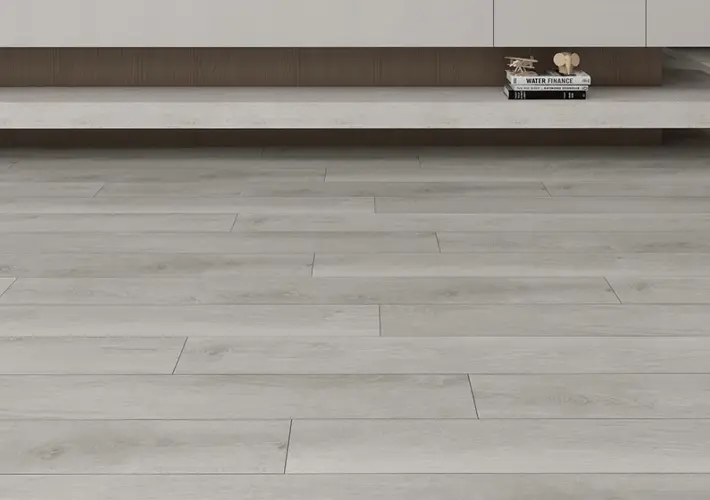
For example, ChangFlor’s NO.1162 wood-grain SPC product is listed in widths of 183 mm, 184 mm, and 228 mm with a length of 1220 mm. This is a product-specific example, not a universal SPC standard. Always verify the exact size, tolerance, packing quantity, and carton coverage for the SKU you are quoting.
2. Separate Total Thickness, Wear Layer, and Backing
These three numbers are often confused. Total thickness describes the complete product. The wear layer is the transparent protective layer above the printed design. The backing or attached pad is the layer underneath, if the product has one.
ChangFlor lists NO.1162 with a total thickness range of 4–8 mm, a wear layer range of 0.2–0.5 mm, and an IXPE or EVA silent pad option. These ranges show why a buyer should request the exact configuration rather than relying on a general product-family description. Confirm whether the quoted thickness includes the attached pad and whether the wear layer is measured by nominal or actual thickness.

3. Check the Core Material and Product Construction
SPC flooring is not defined by appearance alone. Ask what the core is made from, how the layers are built, and whether the supplier can provide a cross-section or technical drawing. For the NO.1162 example, the listed material is PVC + CaCO3 + additive. The exact formula, density, and processing conditions can still vary by product and thickness.
For a commercial order, ask the supplier to confirm the product structure, core density or test method, edge profile, dimensional tolerances, and locking system. This helps you compare like with like when two products have the same headline thickness but different construction.
4. Match the Wear Layer to the Intended Traffic
A thicker wear layer can provide more protection against routine abrasion, but it should not be treated as the only performance indicator. The right choice depends on foot traffic, rolling loads, cleaning frequency, furniture movement, entrance conditions, and the maintenance program.
Ask for the test method, classification, warranty conditions, and recommended application. Compare products using the same basis. A wear-layer number without test information or installation conditions is not enough to predict performance in every project.
5. Verify Water, Dimensional, Fire, Slip, and Acoustic Information
Commercial flooring specifications often need more than a general “waterproof” statement. Request the relevant test reports or declarations for water resistance, dimensional stability, fire performance, slip resistance, sound reduction, and formaldehyde or emissions requirements where applicable.
Check the scope of every document: the tested product code, thickness, backing, test standard, laboratory, issue date, and whether the result applies to the exact configuration being quoted. Do not assume that a report for one construction automatically covers every color or thickness.

6. Review Installation and Subfloor Requirements
A good product can still perform poorly if the subfloor or installation method is unsuitable. Confirm whether the product uses a click system, whether an attached pad is included, and whether an additional underlay is prohibited or recommended.
Before ordering, clarify subfloor flatness, moisture limits, expansion gaps, temperature conditions, transition profiles, and the treatment of large rooms or doorways. Ask for the current installation guide and make sure the quotation identifies the correct accessories.
7. Use This Commercial SPC Specification Checklist
| Specification | What to check | Why it matters |
|---|---|---|
| Dimensions | Length, width, tolerance, format | Takeoff, layout, waste, and packing |
| Total thickness | Core plus wear layer and backing | Transitions, doors, and installation fit |
| Wear layer | Thickness, test method, warranty scope | Commercial abrasion expectations |
| Core construction | Material, density, structure, edge profile | Product comparison and stability review |
| Backing | IXPE, EVA, thickness, included or optional | Acoustic planning and installation method |
| Documents | Test standard, product code, lab, date | Project approval and compliance records |
What to Ask an SPC Flooring Supplier Before Quoting
- Which exact SKU, color, size, total thickness, and wear-layer configuration is available?
- Does the quoted thickness include the attached IXPE or EVA pad?
- What are the carton coverage, pieces per carton, cartons per pallet, and loading quantity?
- Which test reports and declarations apply to this exact product configuration?
- What subfloor, installation, expansion, and maintenance conditions apply to the warranty?
- Can the supplier provide a current sample, technical datasheet, installation guide, and packing details?
- What is the lead time and how will batch consistency be controlled for a repeat order?
A Practical Specification Example
When reviewing a product such as ChangFlor NO.1162, a buyer can record the listed material as PVC + CaCO3 + additive, the available dimensions as 183/184/228 × 1220 mm, the stated total thickness range as 4–8 mm, the wear-layer range as 0.2–0.5 mm, and the silent pad options as IXPE or EVA. The next step is to request the exact quotation configuration and supporting documents for the required market and project.
For more product details, see the ChangFlor NO.1162 product page. You can also compare this checklist with our guides on SPC flooring for office projects and the pros and cons of SPC flooring.
Final Takeaway
The best SPC flooring specification is the one that makes the product easy to compare, approve, install, and reorder. Confirm the complete construction, match the specification to the project, and keep test documents tied to the exact SKU and configuration. This process reduces quotation mistakes and gives commercial buyers a clearer basis for supplier selection.