
When sourcing SPC flooring from China, the lowest price on a quotation is rarely the best purchasing decision. Two suppliers may quote the same price per square meter while offering different thicknesses, wear layers, dimensions, packaging, quality-control procedures, or delivery terms.
For importers, distributors, flooring brands, and project buyers, a useful quotation should make the commercial and technical scope easy to compare. This guide explains how to compare SPC flooring quotes from Chinese manufacturers and how to calculate the real cost before placing an order.
Why SPC flooring quotations can look so different
An SPC flooring quote is based on more than the product name. The price can change when any of the following details change:
- Total thickness and rigid-core construction
- Wear-layer thickness and surface treatment
- Plank or tile size and design collection
- Attached underlayment or no underlayment
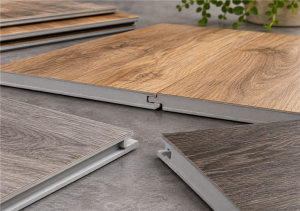
- Click-lock profile and edge treatment
- Packaging method and carton quantity
- Order quantity and production schedule
- EXW, FOB, CIF, or another delivery term
- Custom color, embossing, packaging, or private-label requirements
- Inspection, testing, and documentation requirements
This is why a price comparison is only meaningful when the specifications are aligned. A quote for a 4 mm product with no underlayment should not be compared directly with a quote for a thicker product with an attached pad and custom cartons.
1. Start with a like-for-like specification sheet
Before requesting or comparing prices, prepare one standard specification sheet for every supplier. Ask each manufacturer to complete the same fields. This reduces misunderstandings and makes the commercial comparison much faster.
At minimum, include:
| Item to compare | What to confirm |
|---|---|
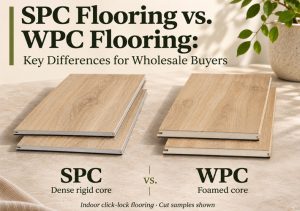
| Product type | SPC rigid-core flooring, dry back, or another construction |
| Overall thickness | Nominal thickness and accepted tolerance |
| Wear layer | Thickness, finish, and surface protection |
| Dimensions | Plank or tile length, width, and dimensional tolerance |
| Core | Core composition, density, and color if relevant |
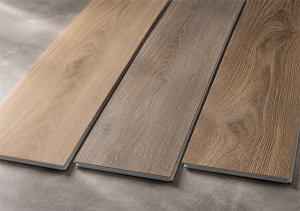
| Surface | Wood or stone design, embossing, gloss level, and registered pattern |
| Underlayment | Attached pad material and thickness, or no pad |
| Locking system | Profile, compatibility, and sample approval process |
| Packaging | Pieces per carton, square meters per carton, cartons per pallet |
| Accessories | Matching skirting, stair nosing, trims, or transition profiles |
Do not rely only on a catalog name such as 鈥渃ommercial SPC鈥?or 鈥減remium rigid flooring.鈥?Those descriptions can mean different things between suppliers. The technical fields above create a common basis for comparison.
2. Check what the quoted price actually includes
Ask every supplier to state the price basis clearly. A quotation should identify the currency, unit, delivery term, packaging scope, and validity period.
Common price terms include:
- EXW: The buyer generally arranges pickup from the factory and manages the export and transport process.
- FOB: The supplier handles the agreed export-side delivery up to the named port, while the buyer usually arranges the main ocean freight and destination-side costs.
- CIF: The quote includes the named port of destination and basic ocean freight and insurance under the agreed terms, but it does not automatically include every destination charge.
The same product can look cheaper under EXW than under FOB or CIF because different logistics costs are excluded. When comparing suppliers, convert every quote to the same basis whenever possible.
Also confirm whether the following are included or excluded:
- Export cartons and palletization
- Printing of private-label cartons
- Sample and color-board charges
- Custom tooling or mold charges
- Inspection fees
- Documentation fees
- Port or destination charges
- Spare cartons and replacement pieces
- Bank charges and payment-related costs
3. Compare total landed cost, not only factory price
For an importer, the useful number is the estimated landed cost. A simple planning formula is:
Estimated landed cost = product cost + export-side charges + freight + insurance + import duties and taxes + destination charges + inland delivery + inspection and handling costs
The final formula will depend on the destination country and the agreed Incoterm. The purpose is not to predict every charge perfectly at the quotation stage; it is to prevent an apparently cheap quote from hiding significant costs elsewhere.
Request the following information before making a supplier shortlist:
- Product price per square meter and per carton
- Carton quantity and total square meters per shipment
- Estimated carton and pallet dimensions
- Gross and net weight
- Recommended container loading quantity
- Production lead time after deposit and artwork approval
- Available shipping terms
- Any export, documentation, or packaging charges
Use a conservative logistics estimate and leave room for inspection, handling, and currency fluctuations. The quote with the lowest factory price may not produce the lowest landed cost.
4. Verify the specification behind the price
The most important quotation fields are the ones that affect performance, replacement cost, and customer expectations. Ask the supplier to confirm each important item in writing and match it against the approved sample.
Total thickness and wear layer
Confirm whether the stated thickness is the total product thickness or only the rigid core. If an attached underlayment is included, ask how the total is measured and whether the wear layer is included in the stated figure.
The wear layer should be stated separately. A quotation that only says 鈥渉igh wear resistance鈥?is not specific enough for a purchase order.
Size and tolerance
Plank dimensions, squareness, locking accuracy, and thickness tolerance can affect installation and visual consistency. Ask for the nominal dimensions and the supplier鈥檚 inspection method. For a private-label product, approve a production sample before mass production.
Surface finish and design repeat
The same design name may look different between factories. Confirm the reference sample, surface texture, embossing, gloss level, bevel, and shade. If the collection uses several design repeats, ask how the patterns are distributed in a carton and whether the buyer can approve the print reference.
Subfloor and installation information
Even though this is a product quotation, the supplier should provide clear installation and subfloor guidance. Confirm whether the product is intended for floating installation, glue-down installation, or another method. Do not use a product quote as a substitute for the installation instructions for the specific collection.
5. Evaluate MOQ, production lead time, and repeat-order terms
Minimum order quantity affects more than the first purchase. A low MOQ may make sampling and market testing easier, while a higher MOQ may support a lower unit price or custom design. Compare the MOQ for:
- Stock colors
- New colors
- Custom embossing or print
- Private-label cartons
- Matching accessories
Lead time should be split into stages: artwork approval, material preparation, production, inspection, and dispatch. Ask what happens if an item is temporarily out of stock or if a custom component is delayed.
For repeat business, confirm whether the supplier can maintain the same surface reference and packaging specification. Ask how shade variation between production batches is controlled and how the factory records approved samples.
6. Look beyond the factory price when assessing quality risk
A lower quote can become expensive if the order has inconsistent dimensions, damaged cartons, shade variation, or a high replacement rate. The supplier evaluation should therefore include quality-control evidence.
Ask the manufacturer about:
- Incoming-material inspection
- In-process checks during extrusion, printing, and finishing
- Locking-profile inspection
- Dimensional and thickness checks
- Carton and pallet inspection
- Final inspection before shipment
- Sample retention and batch traceability
- Handling of non-conforming products
Request relevant test reports and technical documents for the exact product specification being quoted. Check the product name, dimensions, thickness, test scope, date, and issuing laboratory. A generic report for a different collection should not be treated as proof for the product you plan to buy.
7. Use samples to test quotation accuracy
Samples are not only for color selection. They help verify whether the quote describes the actual product.
When the sample arrives, compare it with the quotation and record:
- Overall thickness
- Wear-layer construction
- Plank or tile size
- Edge and locking profile
- Surface texture and gloss
- Backing or underlayment
- Carton labeling and packing quality
- Visual shade and design repeat
Keep an approved reference sample with the purchase order. If there is a difference between the quotation, sample, and production batch, the approved written specification should be the reference for resolution.

8. Build a weighted supplier comparison instead of choosing by price alone
A simple weighted scorecard can make the decision more objective. For example, a buyer may assign higher importance to specification compliance, quality control, and delivery reliability, while still including price as one factor.
Useful scoring categories include:
- Specification match
- Sample quality and consistency
- Factory and quality-control capability
- Price and estimated landed cost
- MOQ and customization flexibility
- Lead time and delivery reliability
- Documentation and communication
- Warranty and after-sales response
Use a clear scoring scale and write a short note for every score. A supplier should not receive a high score for 鈥渜uality鈥?without evidence such as a matching sample, production photos, inspection records, or verifiable technical documentation.
9. Common mistakes when comparing SPC flooring quotes
Comparing different products under the same name
鈥淪PC flooring鈥?is a product category, not a complete specification. Align the construction, dimensions, wear layer, surface, backing, and packaging before comparing price.
Ignoring packaging and loading efficiency
Carton size, pallet configuration, and loading quantity can affect freight cost and damage risk. Request the packing details before calculating landed cost.
Treating a catalog as a purchase order
Catalog information is useful for early selection, but the purchase order should contain the final approved specification and sample reference.
Focusing on the first order only
A supplier may offer a very attractive first-order price but be difficult to manage for repeat production, artwork updates, or quality claims. Include long-term supply capability in the evaluation.
Accepting vague quality promises
Words such as 鈥渂est quality,鈥?鈥渨aterproof,鈥?or 鈥渃ommercial grade鈥?need measurable specifications or supporting documents. Ask what each claim means for the exact product.
10. Questions to send with your RFQ
To receive comparable responses, include a short checklist in your request for quotation:
- What is the exact total thickness and wear-layer thickness?
- Is underlayment included? If yes, what material and thickness?
- What are the nominal dimensions and tolerances?
- What are the pieces and square meters per carton?
- What are the MOQ and lead time for stock and custom products?
- Which Incoterms and ports can you quote?
- What quality-control checks are performed before shipment?
- Can you provide a matching production sample and technical documents?
- What is the expected container loading quantity?
- What are the payment terms, quotation validity, and warranty conditions?
Final checklist before placing an order
Before approving a Chinese SPC flooring supplier, make sure you have:
- A like-for-like comparison sheet
- A clear price basis and Incoterm
- An estimated landed-cost calculation
- An approved physical sample
- A written technical specification
- Confirmed packaging and loading details
- A production and inspection schedule
- Relevant documents for the exact product
- Agreed handling for quality claims and replacements
The best quotation is not always the lowest number. It is the quotation that gives you a clear product specification, realistic total cost, reliable production plan, and enough evidence to manage quality after the order is placed.
If you are comparing SPC flooring suppliers in China, ChangFlor can provide product samples, specifications, packaging options, and a quotation based on your target market and order requirements. Request a free sample or contact our flooring team to discuss your project.
Frequently asked questions
What should I send to a Chinese SPC flooring manufacturer before requesting a quote?
Send the target product type, dimensions, total thickness, wear layer, surface finish, underlayment requirement, packaging needs, estimated quantity, destination port, and any private-label requirements. The more complete the specification, the more useful the quotation will be.
Is FOB always better than EXW for SPC flooring imports?
Not necessarily. The best term depends on your logistics capability, shipment size, destination, and negotiated freight rates. Compare both terms using the same estimated landed-cost calculation.
How can I know whether a quote is for a real manufacturer?
Ask for a factory profile, production photos or video, business details, matching samples, quality-control information, and a clear explanation of which processes are performed in-house. Verify that the company can support the exact product and customization requirements in your RFQ.
Should I order samples before comparing prices?
Yes. Samples help you compare the actual construction, surface, locking profile, and visual quality behind each quote. Price comparison becomes more meaningful after the product scope is aligned.