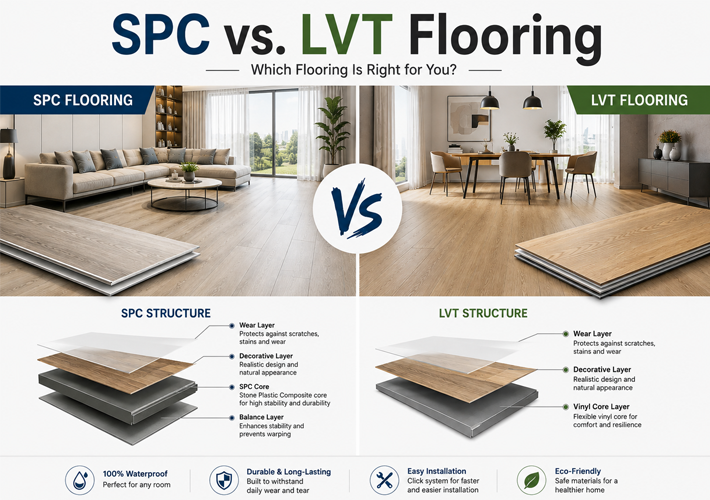
When a distributor, contractor, or project buyer asks us to compare SPC and LVT flooring, we start with the project conditions—not with the claim that one material is always better. Both are vinyl flooring solutions, but their construction, installation systems, formats, and commercial use cases can be different.
At ChangFlor, we supply both SPC flooring and LVT flooring. This guide explains how we normally evaluate SPC vs LVT flooring for a commercial enquiry, so you can shortlist the right construction before requesting samples and a quotation.
SPC vs. LVT flooring: the short answer
SPC is often a strong starting point when a project needs a rigid click-lock plank, a floating installation system, and the dimensional feel of a stone-plastic composite core. LVT may be the better starting point when the project needs more installation-format choices, a lower build-up, loose lay, dry back, self-adhesive, or a specific commercial design direction.
That is a starting point, not a final specification. The subfloor, moisture conditions, finished floor height, wear layer, maintenance plan, local requirements, and installation team can change the decision.
| Decision factor | SPC flooring | LVT flooring |
|---|---|---|
| Core and feel | Rigid stone-plastic composite construction; suitable for buyers who want a firm plank structure. | LVT constructions vary by system; our range includes click, loose lay, dry back, and self-adhesive formats. |
| Installation direction | Often reviewed with a click-lock or floating installation brief. | Choose the installation system that matches the subfloor, programme, and future repair plan. |
| Finished floor height | Compare total thickness, attached pad, transitions, and door clearances. | Some LVT options can support a lower build-up, but the exact product and installation method must be confirmed. |
| Water exposure | Our SPC product pages describe the selected products as waterproof; installation details still matter. | Our LVT product pages also describe selected products as waterproof; verify the exact SKU and subfloor preparation. |
| Best next step | Review the rigid construction, click profile, pad, and complete technical data. | Review the format, adhesive or loose-lay method, surface specification, and replacement requirements. |
The comparison above summarises how we qualify a project. It is not a substitute for the specification of the exact SKU. For a large order, we recommend reviewing the technical sheet, sample, installation instructions, and any market-specific documentation together.
What our current product pages show
To keep the comparison concrete, we use two current ChangFlor product pages as examples. These figures are product-page data for the linked SKUs, not a universal range for every SPC or LVT product.
| Example SKU | Published product-page data | What a buyer should confirm |
|---|---|---|
| SPC NO.1013 | Dimension: 183/184/228 mm × 1220 mm; thickness: 4–8 mm; wear-resistant layer: 0.2–0.5 mm; material: PVC + CaCO₃ + additive. | Exact construction, selected thickness, locking profile, attached pad, test documents, and packaging for the order. |
| Loose Lay LVT NO.87033 | Dimension: 6” × 36”, 7” × 48”, 9” × 48”, or 36” × 36”; thickness: 1.5–5 mm; wear-resistant layer: 0.1–0.7 mm; material: PVC + CaCO₃ + additive. | Loose-lay suitability, friction-grip backing, subfloor flatness, traffic conditions, and the exact surface and colour. |
Our SPC example also lists IXPE and EVA silent-pad options and a 2G drop-lock profile. The loose-lay LVT example describes a no-glue, no-click-lock installation approach. These are useful signals for a first comparison, but they should not be generalised to every product in the category.
Choose by installation system, not only by product name
For SPC, the key installation conversation usually includes subfloor flatness, expansion details, the click profile, underlay or attached pad, transitions, and the finished height. A rigid plank can perform well only when the base and installation details are appropriate.
For LVT, the installation route may be dry back, self-adhesive, click, or loose lay. This creates flexibility for different commercial programmes, but it also means the buyer must specify the system clearly. A loose-lay project, for example, should be reviewed with the selected backing, room conditions, traffic pattern, and subfloor preparation—not simply described as “LVT”.
In renovation work, we ask the installation team to check door gaps, stairs, thresholds, skirting, fixed furniture, and transitions before the order is confirmed. A product that looks attractive on a sample may still be unsuitable if the finished build-up does not coordinate with the site.
Compare wear layer, surface, and maintenance expectations
Commercial buyers often focus on total thickness, but the wear-resistant layer and surface treatment deserve equal attention. The expected traffic, rolling loads, entrance dirt, cleaning products, and replacement plan all affect how the surface will be used.
We recommend comparing the wear-layer figure for the exact SKU, then reviewing the surface texture, embossing, colour consistency, and care instructions. A thicker plank is not automatically the right answer if the wear specification, installation system, or maintenance plan does not match the project.
Where a buyer needs a documented comparison, we can review the applicable requirements and link the discussion to recognised resilient-flooring references such as ISO 10582:2017 or the relevant ASTM resilient floor-covering standards. The applicable edition and test scope should be confirmed for the exact product and destination market.
Which is better for common commercial situations?
| Commercial situation | Our starting discussion | Reason to request a sample |
|---|---|---|
| Office or showroom with a floating-installation brief | Start with SPC click-lock options and compare finished height, surface, and pad. | Check the joint detail, underfoot feel, colour repeat, and transitions. |
| Retail or hospitality renovation with tight height limits | Compare suitable LVT formats with the complete build-up and installation method. | Confirm the actual thickness, backing, adhesive or loose-lay behaviour, and site appearance. |
| Project requiring quick individual plank replacement | Discuss loose-lay LVT where the selected product and site conditions support that method. | Test plank handling, fit, alignment, and the replacement process with the installer. |
| Moisture-prone commercial interior | Both categories can be considered, but product documentation and installation details must be checked. | Review edges, joints, subfloor preparation, cleaning routine, and the exact product claim. |
| Distributor building a wider product range | Carry both SPC and LVT where the market needs different formats, designs, and installation choices. | Compare the sample set, packaging, repeatability, and quotation structure before listing. |
For more detail on selecting flooring for heavy-use areas, you can also read our guide to SPC and LVT flooring for high-traffic commercial spaces. The main principle is the same: match the complete system to the traffic and site conditions.
Our B2B comparison checklist
Before we prepare a recommendation, we ask buyers to share the following information:
| Information | Why we need it |
|---|---|
| Country and project type | Helps us understand the application, market expectations, and required documents. |
| Area, quantity, and installation date | Supports product planning, sample selection, and shipment discussion. |
| Subfloor condition and installation method | Determines whether click, loose lay, dry back, or another system should be reviewed. |
| Target thickness, wear layer, colour, and format | Turns a general request into a comparable product brief. |
| Private-label, packaging, or repeat-order requirements | Allows us to discuss the commercial supply requirements with the product specification. |
Request SPC or LVT samples from ChangFlor
There is no single winner in the SPC vs LVT flooring comparison. The right choice is the one that matches the project’s traffic, subfloor, finished height, installation method, design brief, and procurement requirements.
We can help you compare the exact construction, surface, wear layer, format, packaging, and documentation for your market. Request a free sample from ChangFlor and include your project type, country, estimated quantity, and preferred installation system. If you are still deciding between SPC and LVT, send us both options and we will help you build a practical comparison for your enquiry.