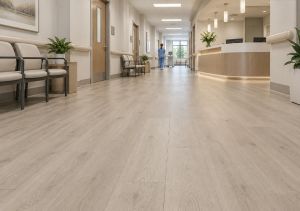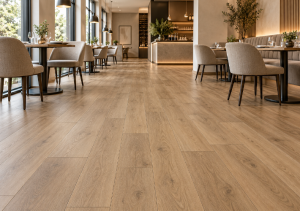
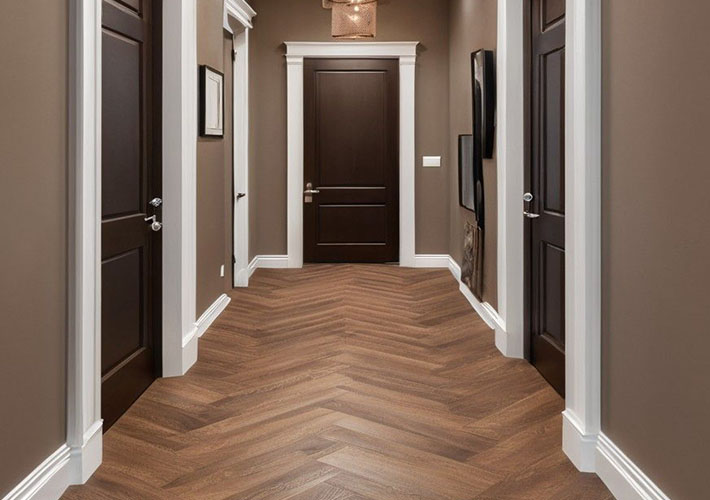
Hotel flooring has to do more than look attractive in a sample room. It must support guest comfort, repeated cleaning, luggage traffic, renovation schedules, and the practical needs of owners, designers, distributors, and contractors. That is why choosing SPC flooring for hotel projects should begin with the project zones and specification—not only the lowest price per square meter.
This guide explains how to evaluate SPC flooring for hotel guest rooms, corridors, lobbies, and other commercial areas. It also shows which details should appear in a supplier quotation and how to turn a design preference into an orderable specification.
What Should Hotel Buyers Expect from SPC Flooring?
SPC flooring combines a rigid stone-plastic composite core with a printed decorative layer, a wear layer, and an optional acoustic backing. For hotels, the value is usually the balance between appearance, moisture resistance, dimensional stability, cleaning convenience, and installation speed.
However, “SPC flooring” is not one universal specification. A product with a 0.2 mm wear layer and a product with a 0.5 mm wear layer should not be quoted as if they were identical. The same applies to total thickness, backing, locking profile, surface finish, and fire or acoustic documentation.
1. Divide the Hotel into Flooring Zones
The first step is to separate the hotel by traffic, cleaning routine, moisture exposure, and visual expectations. A single product may work across several zones, but the decision should be deliberate.
Guest rooms
Guest rooms usually prioritize a residential appearance, underfoot comfort, low visual repetition, and easy turnover between guests. Wood-grain SPC can work well as a design direction, but confirm the required backing, acoustic target, and installation detail before approval.
Guest corridors and lift lobbies
Corridors receive rolling luggage, housekeeping carts, and concentrated foot traffic. This area deserves closer attention to wear-layer thickness, surface texture, joint quality, replacement planning, and the cleaning chemicals allowed by the hotel operator.
Public areas and reception zones
Lobbies and reception areas combine high traffic with strong design expectations. Buyers should compare plank or tile proportions, color consistency, slip-related documentation, scratch resistance, and transition details with adjacent materials.
Back-of-house areas
Staff corridors, service rooms, and other operational areas may have different priorities from guest-facing spaces. Moisture exposure, trolley traffic, maintenance access, and the local building code can affect the final choice. Do not assume that a decorative sample is automatically suitable for every service area.
2. Match the Specification to the Traffic Level
Wear layer is one of the most visible commercial differences between SPC offers. ChangFlor’s NO.1162 product specification lists a 0.2–0.5 mm wear-resistant layer and a 4–8 mm total thickness range. These are product options, not a universal hotel recommendation; the project team should select the actual combination for each zone.
| Hotel zone | What to review first | Quotation detail to request |
|---|---|---|
| Guest rooms | Appearance, comfort, acoustic backing | Surface finish, backing type, plank size |
| Corridors | Wear, rolling traffic, joint stability | Wear layer, thickness, locking profile |
| Lobbies | Traffic, design, transitions | Color batch, surface data, test documents |
| Back of house | Cleaning and moisture exposure | Water, fire, slip, and installation information |
For a deeper explanation of thickness and wear-layer terminology, see ChangFlor’s SPC flooring specifications checklist. It helps buyers compare supplier sheets without confusing total thickness with the wear layer.
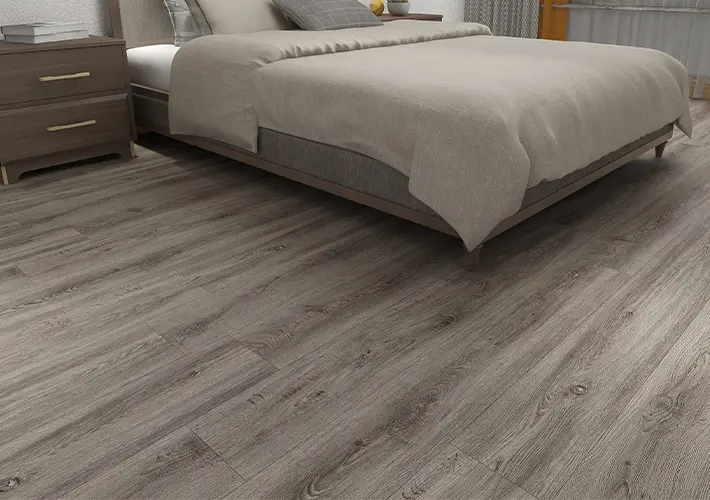
3. Check the Core, Dimensions, and Backing
Hotel buyers should ask for the construction of the exact SKU being quoted. The NO.1162 product page lists PVC + CaCO₃ + additive as the material and 183/184/228 mm × 1220 mm as available dimensions. It also lists IXPE and EVA silent-pad options.
These details affect both design coordination and installation planning. Plank width changes the visual rhythm of a room. Total thickness affects door clearances, skirting, transitions, and the relationship with tile or carpet. Backing affects acoustic expectations, underfoot feel, and the installation build-up.
Request the following in writing:
- Exact plank or tile length and width, with tolerance.
- Total thickness and wear-layer thickness as separate fields.
- Core composition and whether the product is rigid-core SPC.
- Backing type, density or thickness where relevant, and whether it is factory attached.
- Click or loose-lay installation method and joint profile.
4. Review Moisture, Cleaning, and Safety Requirements
Hotels commonly deal with spills, wet cleaning, bathroom-adjacent areas, and frequent housekeeping activity. SPC flooring is often selected for its moisture-resistant construction, but “waterproof” should still be matched with correct subfloor preparation, perimeter detailing, and installation instructions.
Ask the supplier to identify which tests and documents apply to the exact SKU. Depending on the project and country, the documentation package may include water resistance, dimensional stability, fire performance, slip-related information, formaldehyde or VOC data, and acoustic performance. The applicable requirements should come from the project consultant and local regulations.
Also ask the hotel operator for the approved cleaning process. A durable floor can still be damaged by unsuitable chemicals, abrasive equipment, standing water, or maintenance procedures that are not compatible with the surface finish.
5. Confirm Installation and Renovation Practicalities
Hotel schedules often make installation speed important, especially during phased renovation. A floating click system may reduce wet trades and allow a controlled installation sequence, but it does not remove the need for a sound, clean, dry, and sufficiently level subfloor.
Before placing an order, confirm:
- Subfloor moisture and flatness limits.
- Required acclimatization and site storage conditions.
- Expansion gaps, transitions, and movement-joint details.
- Whether the existing floor must be removed or can remain as a substrate.
- How damaged planks will be replaced after handover.
- How color batches will be controlled across floors, rooms, or renovation phases.
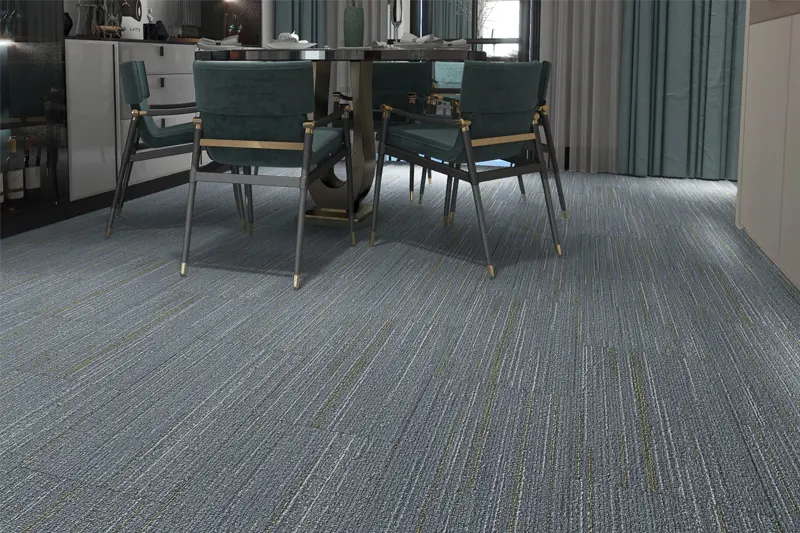
ChangFlor’s NO.1162 page describes a 2G drop-lock profile milled on CNC lines with a stated ±0.02 mm tolerance. Treat this as a product-page specification to verify in the quotation and technical documents, not as a substitute for a project installation method statement.
6. Balance Design Intent with Procurement Control
Hospitality design often starts with a mood board, but procurement needs a repeatable SKU. Record the approved color, surface embossing, plank dimensions, wear layer, thickness, backing, edge profile, packaging, and acceptable shade variation. If the project is delivered in phases, keep a retained sample and photograph the approved reference under neutral light.
For distributors and hotel contractors, it is also useful to distinguish between a standard design and a custom program. Ask whether the supplier can support OEM or ODM changes to pattern, size, wear layer, packaging, or logo, and ask for the MOQ, lead time, and approval process before presenting a custom option to the client.
7. Build a Hotel SPC Flooring Quotation Checklist
A useful quotation should let a buyer compare like with like. Include:
- Project name and hotel zone.
- SKU, color name, and approved sample reference.
- Plank or tile dimensions and total thickness.
- Wear-layer thickness and core material.
- Backing option and installation system.
- Quantity, waste allowance, carton packing, and loading information.
- MOQ, production lead time, sample policy, and port of loading.
- Test reports, declarations, warranty terms, and after-sales process.
- Price basis, Incoterm, payment terms, and quotation validity.
For quantity planning, use the project’s measured area, add a documented waste allowance, and separate standard rooms from irregular public areas. ChangFlor’s article on calculating SPC flooring quantity can help structure the take-off.
Questions to Ask an SPC Flooring Supplier
- Which exact SKU and construction are included in the price?
- Can you provide a full technical sheet and test documents for that SKU?
- What wear-layer and backing options are available for guest rooms and corridors?
- How do you control color, embossing, and dimensional consistency across repeat orders?
- What are the MOQ, lead time, sample process, and replacement-plank policy?
- Which installation and cleaning instructions should the hotel operator follow?
- Can you support OEM/ODM packaging or a phased renovation schedule?
For product-level reference, compare the quotation with ChangFlor’s Wood Grain SPC Vinyl Plank Flooring NO.1162 page. The comparison should confirm that the offer, sample, and technical documents describe the same construction.
Final Takeaway
The best SPC flooring choice for a hotel project is the one that connects the design brief with a controlled, documented specification. Start with the hotel zones, then compare wear layer, thickness, core, dimensions, backing, installation, cleaning, safety documentation, and supply conditions.
For a practical next step, prepare one room sample board and one corridor sample board, record the approved SKU details, and ask the supplier to quote against that written specification. This reduces the risk of comparing different constructions under the same product name and gives the hotel team a clearer basis for approval and repeat ordering.