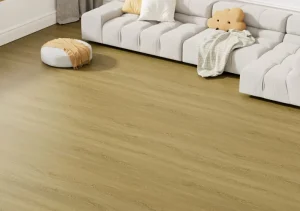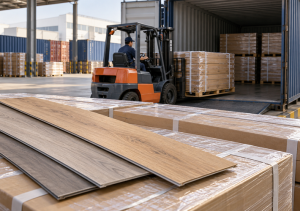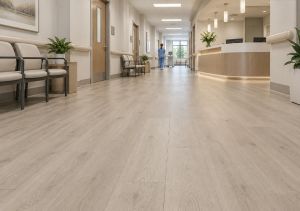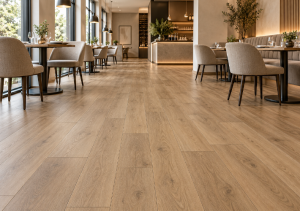
When sourcing SPC flooring from China, price, design, thickness, and delivery time are important—but certifications should also be a key part of your supplier evaluation process. For importers, distributors, contractors, flooring wholesalers, and project buyers, choosing an SPC flooring supplier with appropriate certifications can reduce purchasing risks and provide greater confidence in product quality, safety, and consistency.
SPC flooring, also known as Stone Plastic Composite flooring or Rigid Core flooring, has become increasingly popular in residential, commercial, hospitality, retail, and office projects. However, not every supplier offers the same level of manufacturing quality or quality control. A reliable SPC flooring manufacturer should be able to provide relevant product test reports, factory management certifications, environmental documentation, and market-specific compliance documents.
So, what certifications should an SPC flooring supplier have?
The answer depends on your target market and application. Some certifications demonstrate factory management capabilities, while others verify product performance, chemical safety, fire resistance, environmental characteristics, or compliance with specific market requirements.
For international buyers, it is important to understand what each certification actually proves rather than simply choosing a supplier because it has a long list of certificates.
This guide explains the major certifications and testing documents that buyers should consider when selecting an SPC flooring supplier from China.
Why Are Certifications Important When Buying SPC Flooring?
Certifications and test reports provide third-party or standardized evidence that an SPC flooring product has been evaluated against specific requirements.
For B2B buyers, this can be particularly important because flooring is often purchased in large quantities and installed across large project areas. If the flooring fails to meet expected performance requirements, the resulting costs can include replacement, transportation, installation, project delays, and customer complaints.
A professional supplier should therefore be able to explain:
- Which certifications the factory has
- Which certifications apply to the specific SPC flooring product
- Which laboratory conducted the testing
- Which standards were used
- When the testing was completed
- Whether the certificate or report is still valid
- Whether the tested product matches the product being supplied
This last point is especially important.
A supplier may have a certification for one product specification, but that does not automatically mean every SPC flooring product in its catalog has passed the same testing.
For example, a 4 mm SPC floor with a particular wear layer, underlayment, and surface coating may have different performance characteristics from a 6 mm product with a different structure.
Professional buyers should therefore request documentation for the actual product they intend to purchase.
For international sourcing, certifications can also make customs clearance, project approval, distributor onboarding, and customer acceptance easier.
For a manufacturer such as Changflor, certification and testing are part of a broader quality-control system rather than simply marketing materials. A professional SPC flooring factory should combine raw-material inspection, production control, finished-product inspection, and third-party testing.
ISO 9001: Quality Management System
One of the most useful certifications to look for in an SPC flooring manufacturer is ISO 9001.
ISO 9001 is an international standard for quality management systems. It focuses on how a company manages its processes to consistently provide products and services that meet customer and regulatory requirements.
For an SPC flooring buyer, ISO 9001 does not mean that every individual flooring product has automatically passed a specific performance test. Instead, it provides information about the supplier’s quality-management system.
A factory operating under an ISO 9001 quality management system typically has documented procedures covering areas such as:
- Raw-material purchasing
- Supplier evaluation
- Production processes
- Quality inspection
- Non-conforming products
- Corrective actions
- Customer complaints
- Document control
- Continuous improvement
This can be particularly valuable for distributors and importers who purchase SPC flooring repeatedly.
Imagine that you import several containers of SPC flooring every month. Product consistency is just as important as the quality of the first shipment. You need the supplier to maintain similar specifications, dimensions, colors, locking systems, and surface performance from batch to batch.
A structured quality-management system can help reduce variations.
However, buyers should understand the difference between ISO 9001 certification and product certification.
ISO 9001 primarily evaluates the company’s management system. It does not mean that an SPC floor is automatically waterproof, fire-resistant, scratch-resistant, or suitable for every market.
Therefore, ISO 9001 should be considered one part of a complete supplier evaluation process.
What should buyers check?
When reviewing an ISO 9001 certificate, buyers should check:
- The company name
- The certified factory location
- The scope of certification
- The certification body
- The certificate validity
- Whether the scope covers relevant manufacturing activities
This simple verification step can help buyers avoid relying on irrelevant or outdated certificates.
CE Marking and European Market Compliance
For buyers importing SPC flooring into Europe, CE-related compliance requirements should be carefully considered.
However, buyers should avoid a common misunderstanding: CE marking is not a universal quality certificate for every building product.
The exact CE requirements depend on the product type, intended use, harmonized standards, and applicable European legislation.
For flooring products, documentation may involve product performance declarations, technical documentation, testing, and other conformity requirements depending on the specific product and application.
European buyers should therefore ask the SPC flooring supplier:
- What European standard applies to this flooring product?
- What performance characteristics have been tested?
- Is a Declaration of Performance required?
- What laboratory performed the tests?
- What technical documentation is available?
- Does the documentation correspond to the actual product specification?
For flooring used in residential or commercial projects, product performance can include characteristics such as reaction to fire, dimensional stability, wear resistance, slip resistance, acoustic performance, and other applicable properties.
A professional Chinese SPC flooring supplier should understand that European buyers often require more than a simple CE logo.
The documentation behind the compliance claim is what matters.
For Changflor, European customers can discuss their specific market and project requirements with the factory so the appropriate testing and documentation can be prepared for the target application.
Floor Performance Testing: EN, ASTM and Other Standards
Beyond company-level certifications, buyers should pay close attention to product testing standards.
Different markets may use different standards. European buyers may commonly encounter EN standards, while buyers in the United States and other markets may request ASTM-based testing or other regional requirements.
For SPC flooring, testing can cover many different properties.
Wear resistance
Wear resistance is important because SPC flooring is used in environments ranging from bedrooms to busy commercial spaces.
The surface wear layer protects the decorative layer and helps determine how well the floor performs under traffic.
Buyers should not evaluate wear resistance based only on marketing terms such as “heavy duty” or “commercial grade.” Ask for the actual test method and results.
Dimensional stability
SPC flooring is designed to offer better dimensional stability than many traditional flooring materials, but temperature and environmental conditions can still affect flooring performance.
Dimensional stability testing can help buyers understand how the product behaves under specified conditions.
This is particularly important for markets with significant temperature changes.
Locking strength
The click-lock system is an important component of floating SPC flooring.
A high-quality core material alone does not guarantee a reliable floor. The locking profile needs to be accurately produced and sufficiently strong for installation and normal use.
Buyers should consider test reports related to locking strength and connection performance where applicable.
Slip resistance
For commercial projects, hotels, offices, retail stores, and public spaces, slip resistance can be an important consideration.
The required performance depends on the market, project specification, and installation environment.
Fire performance
Fire performance is especially important for commercial buildings, hotels, offices, shopping centers, and other public projects.
Buyers should request the applicable reaction-to-fire or fire-performance test documentation rather than assuming that all SPC flooring has the same fire behavior.
The exact classification and testing requirements vary according to the destination market and applicable building regulations.
Other performance tests
Depending on the application, buyers may also consider:
- Surface resistance
- Impact resistance
- Stain resistance
- Chemical resistance
- Acoustic performance
- Thermal performance
- Static loading performance
- Color stability
- Dimensional changes
- Bending or mechanical performance
Not every project requires every test.
The best approach is to identify the destination market and application first, then determine which tests are necessary.
VOC, Formaldehyde and Indoor Air Quality Certifications
For flooring installed indoors, chemical emissions can be a major concern.
SPC flooring normally contains PVC-based materials, stabilizers, additives, printing layers, wear layers, and other components. The formulation and manufacturing process can influence emissions and indoor-air-quality performance.
This is why buyers should consider testing related to:
- VOC emissions
- Formaldehyde emissions
- Restricted substances
- Indoor air quality
- Chemical composition
For European and North American markets, buyers may encounter different environmental and chemical requirements.
One important example is REACH compliance for products entering the European market. REACH regulates chemicals and places requirements on substances manufactured or imported into the European Union.
For SPC flooring, buyers should discuss whether the product contains substances that are restricted or subject to specific disclosure requirements.
Another important area is VOC testing.
Low-emission flooring can be particularly attractive for:
- Homes
- Schools
- Offices
- Hotels
- Hospitals
- Retail spaces
- Indoor public areas
However, “eco-friendly,” “non-toxic,” and “low VOC” are not interchangeable claims.
A reliable supplier should support environmental claims with appropriate test reports or certifications.
Why should B2B buyers care about VOC testing?
Suppose you are an importer selling SPC flooring through local distributors.
Your customers may ask whether the flooring is suitable for bedrooms, children’s rooms, offices, or other enclosed spaces.
If the supplier can provide credible emissions testing, it becomes easier for you to answer these questions and support your own product marketing.
This can also reduce the risk of making unsupported environmental claims.
FloorScore and Other Indoor-Air Certifications
For customers targeting North America, FloorScore can be another important certification to consider.
FloorScore is an indoor-air-quality certification program widely associated with resilient flooring products.
It evaluates VOC emissions from flooring and flooring-related products under specified testing conditions.
For distributors, architects, contractors, and green-building projects, indoor-air-quality certification can provide additional confidence when selecting flooring.
Other environmental programs may also be relevant depending on the target market and project.
For example, certain projects may request documentation connected with:
- LEED-related requirements
- Green building programs
- Environmental product documentation
- Indoor air quality
- Recycled content
- Sustainable manufacturing
However, buyers should not assume that a certificate from one program automatically satisfies every green-building requirement.
Each project should be evaluated according to its specification.
For a Chinese SPC flooring manufacturer, the ability to provide market-specific documentation can be an important competitive advantage.
Changflor works with international buyers who may require different specifications depending on the destination market, project type, and customer segment.
SGS, Intertek and Third-Party Test Reports
Another important consideration is third-party testing.
Organizations such as SGS, Intertek, and other qualified laboratories can conduct product testing according to specific standards.
A third-party laboratory report can provide useful evidence of product performance.
However, buyers should focus on the test report details, not simply the laboratory name.
For example, an SGS report may verify a particular property of a specific sample according to a specified testing method. It does not necessarily certify every product manufactured by the factory.
When reviewing a third-party test report, check:
- Manufacturer name
- Product name
- Product model
- Product structure
- Product thickness
- Wear-layer thickness
- Test date
- Testing standard
- Test method
- Test results
- Laboratory information
This is particularly important when buying private-label SPC flooring.
If you are importing a customized SPC product under your own brand, you should make sure that the tested sample corresponds to the final mass-production specification.
Why independent testing matters
Independent testing can reduce disputes between suppliers and buyers.
For example, instead of relying on a supplier’s statement that a floor is “commercial grade,” the buyer can review an actual test result showing the relevant performance under a defined standard.
This creates a more objective basis for procurement.
How to Evaluate an SPC Flooring Supplier Beyond Certifications
Certifications are important, but they should not be the only factor used to select a supplier.
A supplier can have several certificates and still be unsuitable for your business if its production capacity, quality control, communication, or delivery performance is poor.
A complete supplier evaluation should include at least five areas.
1. Product quality
Ask for samples before placing a large order.
Evaluate:
- Surface appearance
- Color consistency
- Board dimensions
- Thickness
- Wear layer
- Click-lock quality
- Core density
- Backing layer
- Packaging
2. Factory capability
For long-term B2B cooperation, determine whether the supplier is a real manufacturer or primarily a trading company.
Questions may include:
- How large is the production facility?
- What is the monthly capacity?
- What production equipment is used?
- How is raw material controlled?
- What inspection equipment is available?
- How are finished products inspected?
3. Customization
Importers often require customized colors, surface textures, dimensions, packaging, and branding.
A capable OEM/ODM supplier should be able to explain:
- Minimum order quantities
- Custom design options
- Private-label packaging
- Product development process
- Sample approval
- Production lead time
4. Quality consistency
One excellent sample is not enough.
Ask how the factory controls production consistency across large orders.
This is where production records, inspection procedures, batch control, and quality management become important.
5. Export experience
An experienced export supplier is more likely to understand:
- Container loading
- Export packaging
- International shipping
- Product labeling
- Commercial documents
- Destination-market requirements
- Distributor requirements
For importers, this can significantly simplify the purchasing process.
What Certifications Should You Ask an SPC Flooring Supplier to Provide?
There is no single certification package that is mandatory for every SPC flooring supplier worldwide.
The appropriate documents depend on your market, product structure, intended application, and local regulations.
However, international buyers can use the following checklist when evaluating a supplier:
| Certification / Document | What It Helps Demonstrate | Typical Buyer Concern |
|---|---|---|
| ISO 9001 | Quality management system | Factory process control |
| CE-related documentation | European conformity requirements where applicable | EU market compliance |
| EN test reports | Product performance under applicable European standards | European projects |
| ASTM test reports | Product performance under applicable ASTM methods | North American markets |
| VOC testing | Chemical emissions performance | Indoor air quality |
| Formaldehyde testing | Formaldehyde emission level | Indoor applications |
| REACH-related documentation | Chemical substance compliance | EU imports |
| FloorScore | Indoor-air-quality performance | North American projects |
| Fire test report | Reaction/fire performance | Commercial projects |
| Slip-resistance test | Surface safety performance | Public/commercial areas |
| SGS/Intertek test reports | Independent product testing | Buyer verification |
This table should be treated as a sourcing checklist rather than a universal legal requirement.
The exact documents needed should always be confirmed against the regulations and specifications of the destination country.
Why Choose Changflor as Your SPC Flooring Manufacturer in China?
For importers, wholesalers, distributors, and project buyers, choosing the right SPC flooring supplier involves much more than finding the lowest factory price.
A professional supplier should provide a combination of product quality, manufacturing capability, documentation, customization, and export support.
Changflor is a China-based SPC and LVT flooring manufacturer serving international B2B customers.
Our product range can be developed for different applications and market requirements, including residential, commercial, retail, office, hospitality, and other interior projects.
As a factory-oriented supplier, Changflor focuses on:
- SPC and LVT flooring manufacturing
- Stable product quality
- OEM and ODM services
- Customized colors and designs
- Private-label packaging
- International wholesale orders
- Product testing and documentation
- Export packaging
- Container shipment support
- B2B customer service
For buyers comparing Chinese SPC flooring suppliers, we recommend evaluating samples, technical specifications, test reports, factory capabilities, and total purchasing costs together.
Rather than choosing a supplier based only on a certificate logo or the lowest quotation, compare the complete supply chain.
A good supplier should be able to clearly answer questions about the SPC flooring’s construction, raw materials, wear layer, core density, click system, testing standards, environmental documentation, packaging, MOQ, production lead time, and shipping.
This approach helps importers establish a more reliable long-term supply relationship.
Frequently Asked Questions About SPC Flooring Certifications
What is the most important certification for an SPC flooring supplier?
There is no single certification that is most important for every buyer. ISO 9001 is useful for evaluating the manufacturer’s quality management system, while product-specific test reports are important for verifying flooring performance. Buyers should prioritize documents relevant to their destination market and application.
Does SPC flooring need CE certification?
CE requirements depend on the specific product, intended use, applicable European legislation, and harmonized standards. Buyers should not assume that every SPC floor automatically requires the same CE documentation. Ask the supplier for the applicable conformity documentation for the exact product.
Is ISO 9001 enough when buying SPC flooring?
No. ISO 9001 evaluates a quality management system rather than proving all performance characteristics of a specific flooring product. Buyers should also request relevant product test reports and compliance documents.
Should I ask for SGS or Intertek reports?
Yes, when third-party testing is relevant to your market or project. However, always check the product model, specifications, testing standard, date, and results to make sure the report applies to the flooring you are purchasing.
What tests are important for commercial SPC flooring?
Commercial applications may require stronger evidence regarding wear resistance, dimensional stability, fire performance, slip resistance, locking strength, stain resistance, and other characteristics. The exact requirements depend on the project and local regulations.
What certifications are important for SPC flooring in the USA?
Requirements vary according to the product and project. Buyers may consider ASTM-based performance testing, indoor-air-quality documentation such as FloorScore where relevant, fire-performance testing, and other applicable compliance documentation.
What certifications are important for SPC flooring in Europe?
European buyers should consider the applicable CE/conformity requirements, relevant EN standards, chemical compliance such as REACH where applicable, VOC or emissions testing, fire performance, and other project-specific documentation.
Can a Chinese SPC flooring factory provide customized certifications?
Testing and certification can often be arranged for specific products and target markets. The feasibility, testing method, cost, and required documentation depend on the product and market. Buyers should discuss their destination-market requirements with the manufacturer before mass production.
How can I verify an SPC flooring certificate?
Check the company name, factory address, product model, certification scope, testing laboratory or certification body, testing standard, issue date, and validity. When possible, verify the document directly through the relevant certification organization or laboratory.
Final Buying Checklist
Before placing a large SPC flooring order, international buyers should request a complete technical and compliance package.
At minimum, consider asking for:
- Company and factory information
- ISO 9001 documentation, if available
- Product technical specifications
- Applicable EN or ASTM test reports
- VOC and formaldehyde test results
- REACH-related documentation for European markets where applicable
- Fire-performance testing when required
- Slip-resistance testing when required
- Third-party laboratory reports
- Product samples
- Packaging specifications
- Warranty and quality-control information
The right certification package depends on where you plan to sell the flooring and how it will be used.
For this reason, the best SPC flooring supplier is not necessarily the company with the largest number of certificates. It is the supplier that can provide relevant, valid, product-specific documentation and consistently manufacture the product according to the approved specification.
For importers and distributors, this can make a significant difference in long-term business performance.
If you are sourcing SPC flooring from China, Changflor can support you with product specifications, samples, OEM/ODM options, packaging solutions, and documentation for international B2B projects.
Looking for a reliable SPC flooring manufacturer in China? Contact Changflor to discuss your target market, product specifications, testing requirements, and wholesale order.